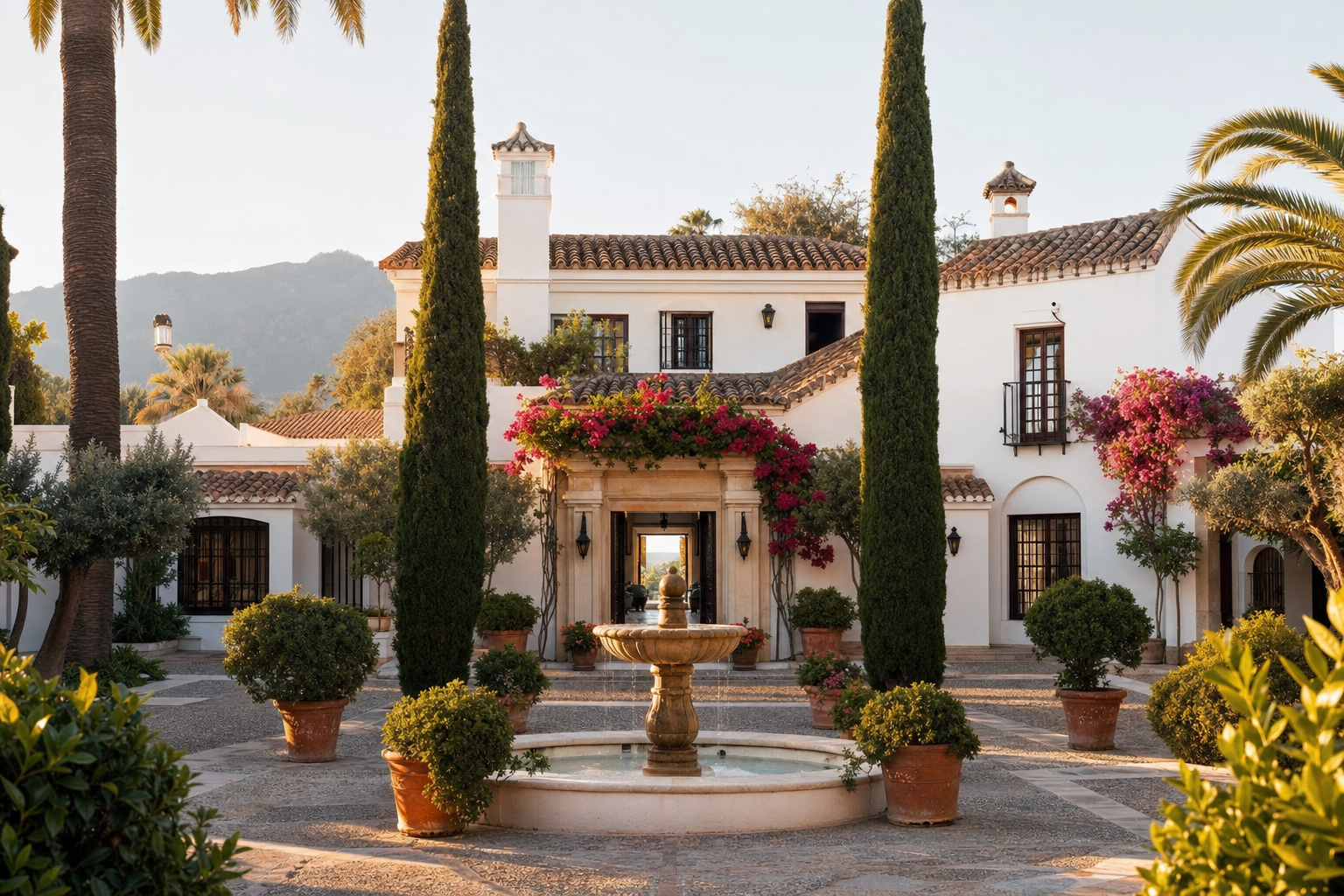
Benahavís is not simply an extension of Marbella. It is a separate municipality — administratively distinct, topographically elevated, and in several respects more desirable for buyers who place privacy, security, and land above proximity to the beach promenade. Yet the vast majority of what is written about Benahavís villas for sale reads identically: golf courses, sea views, mountain village, twenty minutes from Puerto Banús. That shorthand is not wrong, but it tells you almost nothing useful when you are deciding whether to commit several million euros here rather than in Nueva Andalucía, Sotogrande, or the Golden Mile.
This guide is written for buyers who want the substance: what the gated communities differ on, how the transaction works as a non-resident, and where to read what the market is asking today. Current asking prices by zone, each with its sample size and date, are on the Marbella Property Index. Spain publishes no per-property closing prices. Published figures are asking prices, each with its sample size and date.
Why Ultra-Prime Villa Buyers Look at Benahavís
Benahavís contains multiples of everything: gated communities at different elevations, security tiers, golf access levels, and architectural eras. A buyer at the entry of the municipality and a buyer at its top are in the same town hall's records but in entirely different worlds, which is why a single figure for the zone says little.
Four structural reasons account for Benahavís's persistent appeal at the ultra-prime end:
Land availability and plot scale. The municipality covers roughly 146 km² with a population under 7,000 permanent residents. That ratio — vast territory, small population — translates into plot sizes and privacy buffers that are simply unavailable in coastal Marbella, where urban density has been compressing for decades.
Elevation and micro-climate. Properties in Benahavís typically sit between 200 and 600 metres above sea level. Summer temperatures run measurably cooler than on the coast; humidity is lower; nights are genuinely comfortable in July and August. It suits buyers who work remotely or spend six months or more a year here and value year-round liveability over beach adjacency.
Security architecture. The most exclusive communities here operate 24/7 gated perimeters with staffed checkpoints, CCTV-monitored road networks, and strictly controlled visitor access. This level of physical security is functionally impossible to replicate in open coastal urbanisations.
UNESCO and nature adjacency. Benahavís borders the Sierra de las Nieves UNESCO Biosphere Reserve, known for its pinsapo fir forests, ibex populations, and geological significance. The Serranía de Ronda is accessible within an hour. For a buyer constructing a wellness-oriented life rather than a purely social one, this access to preserved wilderness is a genuine differentiator from any coastal address.
The Eight Gated Communities Compared
Understanding Benahavís villa prices is impossible without understanding the communities, because the community determines the kind of product and the lifestyle. Here is an honest comparison of the eight that matter most.
La Zagaleta
The benchmark for ultra-private residential living on this coast: about 230 plots, two private 18-hole golf courses, an equestrian centre, helipad access, and a gated perimeter with staffed 24-hour security. The Marbella Property Index reports La Zagaleta as a zone of its own, with its sample size and date.
El Madroñal
Elevated, forested, and architecturally diverse, El Madroñal sits above the AP-7 corridor at altitudes that provide genuine coolness. Plots tend to be generous; architectural styles range from classic Andalusian cortijo to modernist statements. Security is gated but less intensively staffed than La Zagaleta. The Marbella Property Index reports El Madroñal as a zone of its own.
La Quinta
Golf-centric and well-connected, La Quinta borders the La Quinta Golf & Country Club and offers relatively easy access to San Pedro de Alcántara and Puerto Banús. It attracts a buyer who wants proximity to amenities alongside the gated environment — fractionally more accessible than El Madroñal.
Los Flamingos
Home to the Villa Padierna resort and directly integrated with the Flamingos Golf course. Los Flamingos appeals to buyers who want a five-star hotel infrastructure on their doorstep — spa, restaurants, and manicured grounds — combined with private villa ownership.
El Herrojo
A sub-community within the La Quinta area, El Herrojo is quieter and more established. Properties here tend to be larger individual villas with mature gardens; it is a choice for buyers who prioritise space and quiet over resort-style amenities.
Monte Mayor
Arguably the most dramatic natural setting in Benahavís municipality: a hilltop community at significant elevation with panoramic views across the Mediterranean toward Africa on a clear day. Architecture tends toward the substantial; the community is small.
La Alquería
More recently developed, La Alquería attracts families and buyers entering the gated-community market below the level of La Zagaleta or El Madroñal. Contemporary architecture dominates.
Marbella Club Golf Resort
Directly affiliated with the Marbella Club brand, this is the smallest and most brand-curated community on the list. It offers frontline golf positions, strict architectural guidelines, and a well-maintained common infrastructure.
Benahavís Villa Prices: Where to Read Them
No price band is typed on this page: asking prices move, and a figure written here would be out of date by the time you read it. Current asking prices by zone, each with its sample size and date, are on the Marbella Property Index. Benahavís, La Zagaleta and El Madroñal are reported there as separate zones. Spain publishes no per-property closing prices. Published figures are asking prices, each with its sample size and date.
What changes as the budget rises is the kind of product rather than the address. At the entry of the municipality the stock is typically a resale villa in an established urbanisation, often needing modernisation, or a contemporary townhouse-style villa in La Alquería or a comparable community. In the middle sits the widest range — well-renovated traditional villas in La Quinta, contemporary builds in Los Flamingos, and frontline golf positions. Above that come substantial plots, high-specification finishes and coastline views in El Madroñal and comparable communities, and at the top new-build properties with smart-home integration, staff quarters and wellness suites.
Three eight-bedroom villas on the register illustrate that top tier; each page carries the current asking price:
- 8-bedroom villa in Benahavís (ZD-THH11)
- 8-bedroom villa in Benahavís (ZD-CORQ)
- 8-bedroom villa in Benahavís (ZD-THH12)
Some residences are not published and are shown by introduction. To ask about those, write to the desk.
New Build vs Resale vs Off-Market: Three Routes to a Benahavís Villa
The route to a Benahavís villa differs by the kind of stock, and so do the taxes.
New build and off-plan villas in Benahavís carry IVA at 10% plus Actos Jurídicos Documentados (AJD) at 1.2% in Andalucía — a total purchase tax of 11.2% on top of the agreed price, and no ITP. The advantage is that you are buying a product designed to current standards: energy efficiency ratings, smart-home integration, and contemporary finishes.
Resale properties carry Impuesto de Transmisiones Patrimoniales (ITP) and no AJD. ITP on a resale in Andalusia is 7% of the price, or of the Catastro's reference value if that is higher (Article 41 of Andalusia's Ley 5/2021; Article 10.2 of the ITP-AJD law). Many of the most characterful villas in El Madroñal and established La Quinta positions are resale. You can physically inspect what you are purchasing.
Off-market is the third route. Some residences are not published and are shown by introduction. The share of sales that never reach a portal cannot be measured: Spain publishes no record of how a buyer was found. Owners at La Zagaleta and comparable communities may prefer a discreet sale — both to avoid signalling their intentions to the market and to limit viewings by unqualified parties. Residences marked Muse exclusive are the firm's own mandates; the others come from the shared listing feeds. For the published stock, start with the published register; for a residence that is not published, write to the desk.
The International Buyer's Legal & Tax Roadmap
No public dataset records buyer nationality at this price level. For a buyer who is not resident in Spain, the legal and tax landscape is material and frequently misunderstood.
NIE (Número de Identificación de Extranjero): Spain's foreign identification number. Every non-Spanish buyer must obtain one before completing a property purchase. It can be obtained at a Spanish consulate in your home country or in Spain directly; a local lawyer or gestoría can manage the process. Without it, the notarial deed cannot be signed.
Purchase structure: The typical sequence is: instruction of an independent Spanish lawyer → signing of a Contrato de Reserva (reservation contract, typically securing the property for a small deposit) → Contrato de Arras Penitenciales (private purchase contract with 10% deposit, both parties bound) → escritura pública de compraventa signed before a notary, at which point the balance is paid and title transfers.
Golden Visa: Spain's investor residence visa (the Golden Visa) — every route, not only property — was abolished by Ley Orgánica 1/2025 of 2 January (final provision 21), in force since 3 April 2025. Buying property gives no right of residence at any price. Applications filed before that date are decided under the old rules, and permits already granted keep their validity and can be renewed under them. Buyers interested in residency should take legal advice on the routes that remain, such as the Non-Lucrative Visa or the Digital Nomad Visa.
Non-resident taxation (Modelo 210): Non-resident property owners in Spain are subject to Spanish non-resident income tax (IRNR). For 2026, a non-resident individual who does not let the property is taxed on a deemed income of 1.1% or 2% of the cadastral value, depending on when that value was last revised; the rate is 19% for EU/EEA residents and 24% for others. It applies to individuals, not companies. Rent received by a non-resident is taxed at 19% on income net of expenses for EU/EEA residents and at 24% on gross income for everyone else (Articles 24 and 25.1.a of the IRNR law). The tax is IRNR, not IRPF. Since Brexit, UK residents fall in the second group. Proper tax structuring before purchase — whether via direct ownership, a Spanish SL, or an international holding structure — is worth significant professional attention.
For EU buyers: the process is more straightforward, but currency hedging (for non-euro-denominated buyers) and wealth tax (Impuesto sobre el Patrimonio) are both worth pre-purchase planning. Andalusia gives 100% relief on wealth tax (Article 25 bis of Ley 5/2021). While the state Temporary Solidarity Tax on Large Fortunes (ITSGF) is in force, that relief is limited to the difference between the two bills, so above the threshold the taxpayer pays what the solidarity tax would charge. Nothing is due while net wealth after the €700,000 allowance stays within €3,000,000; above that the scale is 1.7% to €5,347,998.03, 2.1% to €10,695,996.06 and 3.5% beyond (Article 3 of Ley 38/2022). Non-residents have the same €700,000 allowance and are assessed on their Spanish assets only (Article 28.Tres of Ley 19/1991).
Lifestyle Beyond Golf — Sierra de las Nieves, Wellness Living & the Micro-Climate Advantage
The "golf and sea views" shorthand is not inaccurate, but it sells Benahavís short for a particular kind of buyer: the high-net-worth individual who is permanently or semi-permanently relocating, not purchasing a three-week holiday asset.
The Sierra de las Nieves UNESCO Biosphere Reserve begins where the upper Benahavís communities end. Hiking trails through pinsapo fir forest, rock-climbing routes on limestone faces, and mountain-bike circuits at elevation are accessible from your villa without entering a motorway. The reserve's UNESCO designation reflects genuine ecological significance — it is not a managed park but a working landscape.
The Serranía de Ronda, accessible within an hour, offers the historic city of Ronda — one of Spain's most architecturally remarkable towns — alongside equestrian culture, local wine production, and a social scene entirely distinct from the coastal circuit.
The micro-climate benefit is real and measurable in lifestyle terms, if not in the data available here. At 400 metres elevation, summer evenings are genuinely temperate. Afternoon thunderstorms that bring drama to August evenings clear the air without the coastal humidity that makes low-lying Marbella uncomfortable for those working or exercising outdoors. For buyers spending six months annually at their property, this matters considerably more than it does for a two-week holidaymaker.
Rental Income & Resale: What Can and Cannot Be Measured in Benahavís
No rental yield is published: no public dataset records achieved rents or closing prices for these homes. No appreciation or year-on-year figure exists for these addresses: it would need closing prices at two dates, and Spain publishes none. Current asking prices by zone, each with its sample size and date, are on the Marbella Property Index.
What can be said without a number: new land inside the premium communities is limited, and the municipality has been restrained about new development. Letting a villa in a gated community is possible where the community statutes and a tourist licence allow it; whether it pays for a particular house is a question for that house's own booking records and costs, not for a zone average.
How to Buy a Villa in Benahavís — Our Step-by-Step Process
1. Define the brief precisely. Security tier, elevation preference, golf access requirement, minimum plot, architectural style, and budget ceiling including taxes and fees. Benahavís is large enough that without a genuine brief, the search is unmanageable.
2. Engage independent legal counsel. Before viewing a single property, instruct a Spanish property lawyer independent of any agency. Their role is title verification, urban planning compliance checks, community fee status, and debt searches on the property.
3. Search the published register and ask about the rest. Browse the published register, or describe the brief to Ask Muse, the AI search on this site. Some residences are not published and are shown by introduction. To ask about those, write to the desk.
4. Obtain your NIE. Do this in parallel with your search. It takes time and you will need it to complete.
5. Reservation and due diligence. Once a property is identified, a Reserva is signed and a small deposit paid to secure the property while full due diligence is conducted. This is a critical window — do not skip the technical survey.
6. Arras contract. At 10% deposit, both parties are contractually committed. The seller forfeits double the deposit if they withdraw; the buyer forfeits the deposit if they do.
7. Escritura at notary. The final deed is signed before a Spanish notary. The balance — with IVA, on a new build — and the notary's invoice are paid at this stage. ITP on a resale, or AJD on a new build, is self-assessed on Modelo 600 and paid to the Junta de Andalucía within two months, counted from the day after the deed is signed (Article 69 of Ley 5/2021). In the worked examples at €2–5 million — notary and land registry as estimated invoices, lawyer at 0.75% plus IVA — the total comes to 8.0–8.2% on top of the price for a resale and 12.2% for a new build. Only the tax is fixed by law; the other lines are estimates.
8. Post-completion. Utility transfers, community registration, annual Modelo 210 filing for non-residents, and property insurance should all be addressed within weeks of completion.