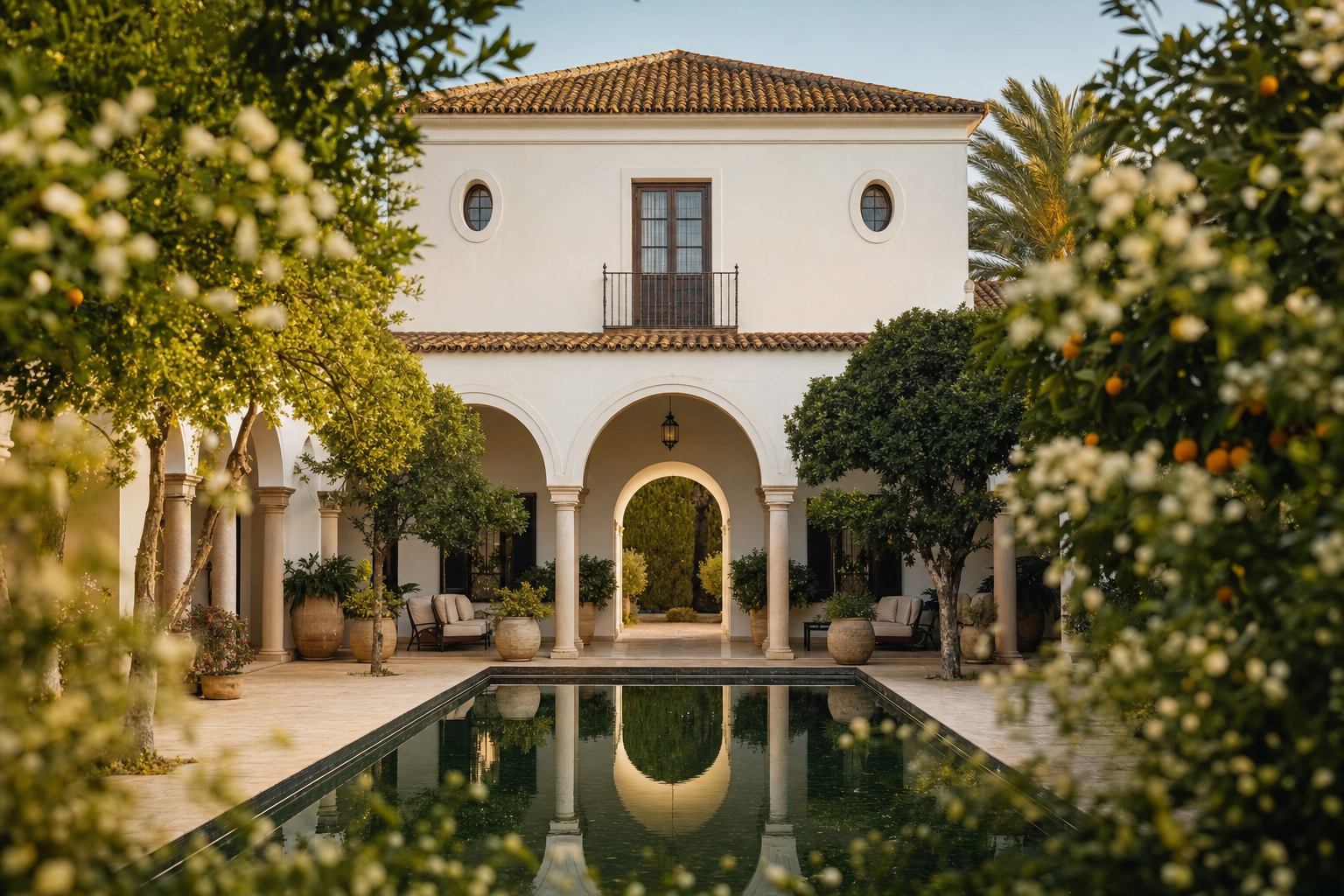
El Madroñal sits in one of the most deliberate blind spots of the Costa del Sol property market. It is not the area with the most listings, the loudest marketing, or the most recognisable name outside Europe's private-wealth circles — and that, for a significant number of buyers, is precisely the point. This guide is written for those who have already progressed beyond browsing aggregator portals and want a substantive, honest account of what El Madroñal actually offers in 2025: where the value lies within the community, how it compares to La Zagaleta, what the current market data shows, and what it costs — in full — to complete a purchase here.
What Makes El Madroñal One of the Costa del Sol's Most Coveted Gated Estates
El Madroñal occupies a privileged position in the foothills of the Sierra de las Nieves, within the municipality of Benahavís — consistently one of the wealthiest municipalities per capita in Spain. The estate sits above the A-397 Ronda Road at an elevation that delivers genuine panoramic views of the Mediterranean on clear days, while its dense cork oak and pine woodland creates a sense of seclusion that purely coastal locations simply cannot replicate.
The gated perimeter, 24-hour security, and strictly enforced architectural guidelines have kept the community's character intact since its development in the 1980s and 1990s. Unlike some Marbella-adjacent estates that have gradually densified or allowed stylistic incoherence, El Madroñal retains a coherent low-density feel: large plots, mature landscaping, and villas set well back from internal roads. The result is a community that feels private in a way that a sea-view penthouse, however luxurious, never quite achieves.
For buyers accustomed to gated estates in the Algarve, Tuscany, or the French Riviera, El Madroñal tends to stand out for its scale-to-price ratio and for the quality of the mountain-meets-sea setting. The drive to Puerto Banús takes roughly 20 minutes; Marbella's Golden Mile is under 25 minutes. You are not sacrificing convenience for seclusion.
El Madroñal vs. La Zagaleta — Which Is Right for You in 2025?
This is the comparison that every serious buyer in this price bracket eventually makes, and it deserves a direct answer rather than the diplomatic non-answer most agents provide.
La Zagaleta is the larger and more internationally recognised estate. It has two private golf courses, an equestrian centre, a helipad, and an on-site clubhouse. Its security protocol is armed and highly visible. The community's infrastructure is designed around self-sufficiency: residents rarely need to leave the estate for leisure during a weekend stay. Price levels at La Zagaleta are, on the whole, higher, and the market is thinner — properties sell less frequently, which creates both a scarcity premium and liquidity risk.
El Madroñal offers a different proposition. The community is smaller and more intimate, without the resort-infrastructure overlay. There are no golf courses within the perimeter, which means residents tend to integrate more naturally with the wider Benahavís and Marbella area — the valley below contains several of the Costa del Sol's finest golf courses, including Aloha, Las Brisas, and Los Naranjos, all within 15–20 minutes. The security is professional and effective without the paramilitary aesthetic that some buyers find either reassuring or, depending on their background, unnecessary.
From a pure value perspective, the Muse Property Index shows El Madroñal's current median at €9,150,000 with a median price per square metre of €8,055/m². That places it above the wider Benahavís market (median €4,990,000; €7,051/m²) and above the broader Marbella market, reflecting the premium the community commands. La Zagaleta is not represented as a separate zone in our current index, but anecdotally and from publicly available sales data, headline prices regularly exceed €15M–€20M for top-tier villas, with €/m² figures that can surpass El Madroñal's significantly.
The honest summary: if self-contained resort living with private golf and a strong brand recognition among UHNW peers is the priority, La Zagaleta has a compelling case. If you want a genuinely private, architecturally curated hillside community with strong connectivity to wider Marbella life and competitive €/m² value at the €5M–€12M tier, El Madroñal frequently wins the comparison.
Inside the Community: Sub-Zones, Gates, Views, and Plot Sizes Explained
El Madroñal is not a single homogeneous estate. It is divided into numbered sub-zones (broadly referred to as El Madroñal 1 through to the upper sections), each with distinct characteristics that affect both lifestyle and value. Buyers who treat the community as a single price point tend to be surprised when they visit multiple properties.
Lower sectors (accessed via the main lower gate) tend to offer the most convenient access — shorter drives from the Ronda Road junction, easier deliveries and contractor access, and in some cases slightly larger internal road widths. The trade-off is elevation: south-facing plots here can deliver strong sea views, but the treeline and topography mean some parcels look more toward the valley floor than the coast.
Upper sectors and elevated plots command a premium for demonstrable reasons. At the estate's higher elevations, the vista opens dramatically: on a clear winter morning you can see across the Mediterranean to the Moroccan coastline. These plots also benefit from cross-ventilation and are cooler in summer — a factor that is increasingly relevant as temperatures along the coast push higher. Access requires navigating the community's internal road network, which can add a few minutes to routine journeys, but most residents regard this as a fair exchange.
Forest-facing plots on the northern and eastern edges of the estate are a different product entirely. Sea views are limited or absent, but the setting — a private villa backed into a cork oak forest with essentially zero visible neighbours — appeals to a specific buyer archetype: those for whom absolute visual solitude outweighs the prestige of the sea view. These plots occasionally trade at a modest discount relative to comparable south-facing land, which creates interesting acquisition opportunities.
Plot sizes across the community are generous by any Costa del Sol standard, reflecting the original planning parameters. New-build and renovation projects must comply with strict build-to-plot ratios and aesthetic guidelines, which acts as a quality floor: you cannot build a speculative glass box on a small plot and call it done.
For buyers seeking off-market opportunities or wanting to understand which specific sub-zone best fits their brief, speaking directly with a Muse curator is the most efficient route — the granular, gate-by-gate intelligence simply does not exist in the public domain.
El Madroñal Villa Price Guide 2025 — What Your Budget Gets You
Based on the Muse Property Index, the current El Madroñal market spans from approximately €4,950,000 at the lower end to €17,000,000 at the top of the listed range, with a median of €9,150,000.
€5M–€7M typically accesses established villas with four to six bedrooms, often on large mature plots in the mid-elevation zones. Many of these represent classic-period construction (1990s–2000s) that has been partially modernised; a thoughtful buyer can identify properties where the bones — the plot, the orientation, the internal volume — are strong, and where a targeted renovation programme delivers significant value uplift.
€7M–€12M is where the bulk of contemporary-standard inventory sits. This tier covers recently renovated villas and newer-build projects that comply with El Madroñal's aesthetic parameters while incorporating modern open-plan layouts, home automation, infinity pools, and quality-of-life amenities that today's buyers expect at this price point.
Above €12M you are in the territory of exceptional plots with bespoke architecture, the largest footprints, the highest elevations, and the most dramatic views. Transactions at this level are often off-market and move slowly — sellers are rarely motivated by urgency, and buyers are highly specific about what they want.
To give concrete context: two current Benahavís-area listings on the Muse portfolio illustrate the upper end of the market. A striking 8-bedroom, 8-bathroom villa of 1,343 m² is listed at €20,000,000, while a substantial 8-bedroom, 9-bathroom residence of 1,696 m² is offered at €19,880,000. Both represent the kind of architecturally ambitious, large-footprint product that defines the upper Benahavís market, and are worth studying as reference points for what premium construction looks like at scale here. For buyers whose brief is slightly different — perhaps a statement villa slightly closer to the coast — the 7-bedroom Nueva Andalucía villa at €19,500,000 offers a useful comparison.
Explore the full current Muse portfolio for available listings across all price tiers.
Market Performance: Price Growth, Demand Drivers, and Investment Case
The Benahavís municipality — within which El Madroñal sits — has recorded consistent price appreciation over the past several years, driven by a combination of constrained supply, inward migration from Northern Europe and the Middle East, and the reputational pull of the wider Marbella area. The Muse Property Index places the current Benahavís-wide median at €4,990,000 with an average of €7,639/m², while El Madroñal specifically records a median of €8,055/m² — a meaningful premium over the municipality average that reflects the estate's scarcity and quality controls.
Several structural factors support the investment case for El Madroñal in 2025:
Supply constraint is genuine. The estate is fully built out in planning terms; there are no large undeveloped land banks. New supply enters the market only through plot resales and demolition-rebuild cycles, meaning that demand increases translate more directly into price appreciation than in open-market developments where a new phase can absorb buyer interest.
Demand drivers remain robust. The post-2020 structural shift toward remote and hybrid work continues to support full-time and primary-residence purchases by buyers who would previously have bought a secondary holiday home. The Benahavís-Marbella corridor is one of very few European markets where a full-time family lifestyle is genuinely feasible in a luxury gated setting — international schooling is available, connectivity is good, and the climate is exceptional.
The Golden Visa phase-out is not the threat it appears. Spain's decision to wind down the property-based Golden Visa route primarily affects sub-€500,000 investment-grade purchases. At El Madroñal's price points, buyers are overwhelmingly purchasing for lifestyle and capital preservation, not visa qualification. Demand at this level is driven by wealth, not immigration programme mechanics.
Comparative value within the index. At €8,055/m² median, El Madroñal sits notably above the wider Benahavís average but below Nueva Andalucía (€10,154/m²) and the Marbella Golden Mile (€8,801/m²). For buyers who understand what the estate actually offers — the elevation, the seclusion, the plot sizes — that comparative position represents genuine value.
Architecture and Design Trends: From Classic Cortijos to Award-Winning Modern Villas
El Madroñal's architectural story is one of quiet but significant evolution. The estate's original character was defined by Andalusian-influenced design — thick white render, terracotta rooflines, interior courtyards, and landscaping heavy with lavender, rosemary, and bougainvillea. Many of these classical villas remain, and the best-maintained examples remain highly desirable for buyers who want an aesthetic authentic to the region rather than a design statement.
From roughly 2010 onwards, a wave of modernist and contemporary architecture began to appear on renovation and new-build projects. Architects working in the community have increasingly embraced open-plan volumes, floor-to-ceiling glazing designed to frame the landscape, clean geometric forms, and what has become broadly known as biophilic design — buildings that integrate the surrounding pine and cork oak forest rather than simply occupying the plot. Infinity pools positioned to disappear into the horizon have become standard at the upper end; basement entertainment levels, dedicated staff quarters, and home automation systems are now baseline expectations rather than premium features.
The most sophisticated current projects go further, prioritising passive solar design, cross-ventilation strategies that minimise air-conditioning load, and materials — local stone, recycled wood, natural plasters — that age well in the mountain microclimate. This eco-luxury direction is increasingly important to younger UHNW buyers, particularly those from Northern Europe and the US, for whom sustainability credentials are a genuine purchase criterion rather than a marketing addition.
For buyers evaluating renovation stock versus new-build, the key distinction in 2025 is this: a well-located 1990s villa on an exceptional plot with strong orientation and views is frequently a better investment than a contemporary new-build on a less favourable position within the estate. The architecture can be replaced; the plot cannot.
Daily Life in El Madroñal — Schools, Golf, Dining, and Getting to the Coast
Understanding the rhythm of daily life in El Madroñal matters, particularly for buyers relocating full-time or planning extended family use.
Education: The Costa del Sol has one of Spain's strongest concentrations of international schools. Laude San Pedro International College, Aloha College, and the English International College are all within a 20–30 minute drive, serving British, IB, and other curricula. For families with younger children, the school run from El Madroñal is entirely manageable; the roads are clear outside of high summer.
Golf: The Benahavís valley is sometimes described as the golf capital of Europe, and the access from El Madroñal is genuinely excellent. Aloha Golf Club, Los Naranjos, and La Quinta Golf are all within a short drive. The Real Club de Golf Las Brisas — one of the oldest and most distinguished clubs on the coast — is also accessible in under 20 minutes.
Dining and retail: The village of Benahavís itself, a short drive up the valley, has earned a disproportionate culinary reputation for its size — the main street is lined with restaurants that draw visitors from across the coast. For higher-end dining and retail, Puerto Banús and Marbella offer everything from Michelin-recommended restaurants to international luxury brands. The drive to Puerto Banús takes approximately 20 minutes from the lower gates.
The coast: El Madroñal is not a beachfront community, and buyers who make that their primary criterion will look elsewhere. But the coastline — including the beaches of San Pedro de Alcántara and Puerto Banús — is genuinely accessible within 20 minutes, which satisfies most families comfortably. The mountain setting is the trade, not the compromise.
Getting further afield: Málaga Airport is approximately 45–55 minutes by car, well-served by direct long-haul and European routes. Gibraltar Airport is around an hour to the west, offering additional flexibility for private aviation users.
Buying a Villa in El Madroñal: Step-by-Step Process, Taxes, and Legal Checklist
Purchasing a villa in El Madroñal follows the standard Spanish conveyancing process, but at this price point the due diligence layers are more extensive and the tax exposure more significant. Here is a clear-eyed guide.
The Process
1. NIE (Número de Identificación de Extranjero): Non-Spanish buyers must obtain a Spanish tax identification number before completing any property purchase. This can be obtained via a Spanish consulate in your home country or in Spain itself; many buyers appoint a Spanish lawyer to handle the application by power of attorney. Allow several weeks.
2. Reservation / Offer letter: Once a property is identified, a reservation fee (typically €6,000–€10,000) is paid to take the property off the market during due diligence. This is refundable if the deal does not proceed.
3. Due diligence: Your Spanish lawyer (essential — do not proceed without independent legal representation) will review the nota simple (Land Registry extract), check for encumbrances, verify planning permissions, confirm community fee status, and review the catastro (cadastral record) for any discrepancies. For El Madroñal properties, community-specific covenants and architectural guidelines should be reviewed carefully.
4. Private Purchase Contract (Contrato de Arras): A formal contract is signed and a deposit — typically 10% of the agreed purchase price — is paid. If the buyer withdraws without cause, the deposit is forfeit. If the seller withdraws, they return double the deposit.
5. Completion (Escritura) at Notary: The deed of sale is executed before a Spanish notary. Balance of funds is transferred, typically by banker's draft. The escritura is then registered at the Land Registry.
Taxes and Acquisition Costs
Resale properties (ITP — Impuesto de Transmisiones Patrimoniales): In Andalucía, the standard rate is 7% of the declared purchase price. On a €9,000,000 resale villa, this is €630,000 in transfer tax alone.
New-build properties (IVA + AJD): New-build residential sales attract IVA at 10% of the purchase price, plus Actos Jurídicos Documentados (stamp duty) at approximately 1.2% in Andalucía. On a €9,000,000 new-build, total tax exposure is approximately €1,008,000.
Additional costs: Notary fees, Land Registry fees, and legal fees (typically 1–1.5% for a reputable Spanish lawyer) add further to the acquisition cost. Buyers should budget a total acquisition cost of approximately 9–13% above the purchase price, depending on whether the property is resale or new-build.
Ongoing costs: Annual IBI (Impuesto sobre Bienes Inmuebles) — Spain's equivalent of council tax, calculated on the cadastral value — is payable by all property owners. Community fees for El Madroñal cover security, road maintenance, and communal landscaping; these vary by sector and property size. Buyers should request the full community fee schedule and check for any outstanding arrears before exchange.
Wealth tax (Impuesto sobre el Patrimonio): Non-resident buyers with significant Spanish assets should take specialist advice on wealth tax exposure; Andalucía's current regional government has historically applied significant exemptions, but this is subject to political change.
For buyers at this level, working with a bilingual Spanish tax lawyer and a currency specialist (to manage the FX risk on a multi-million-euro transfer) is straightforward professional practice, not optional.
Ready to explore El Madroñal villas for sale with the depth of market intelligence this decision deserves? Browse the current portfolio or speak with a Muse curator for access to off-market listings and sub-zone-specific guidance.