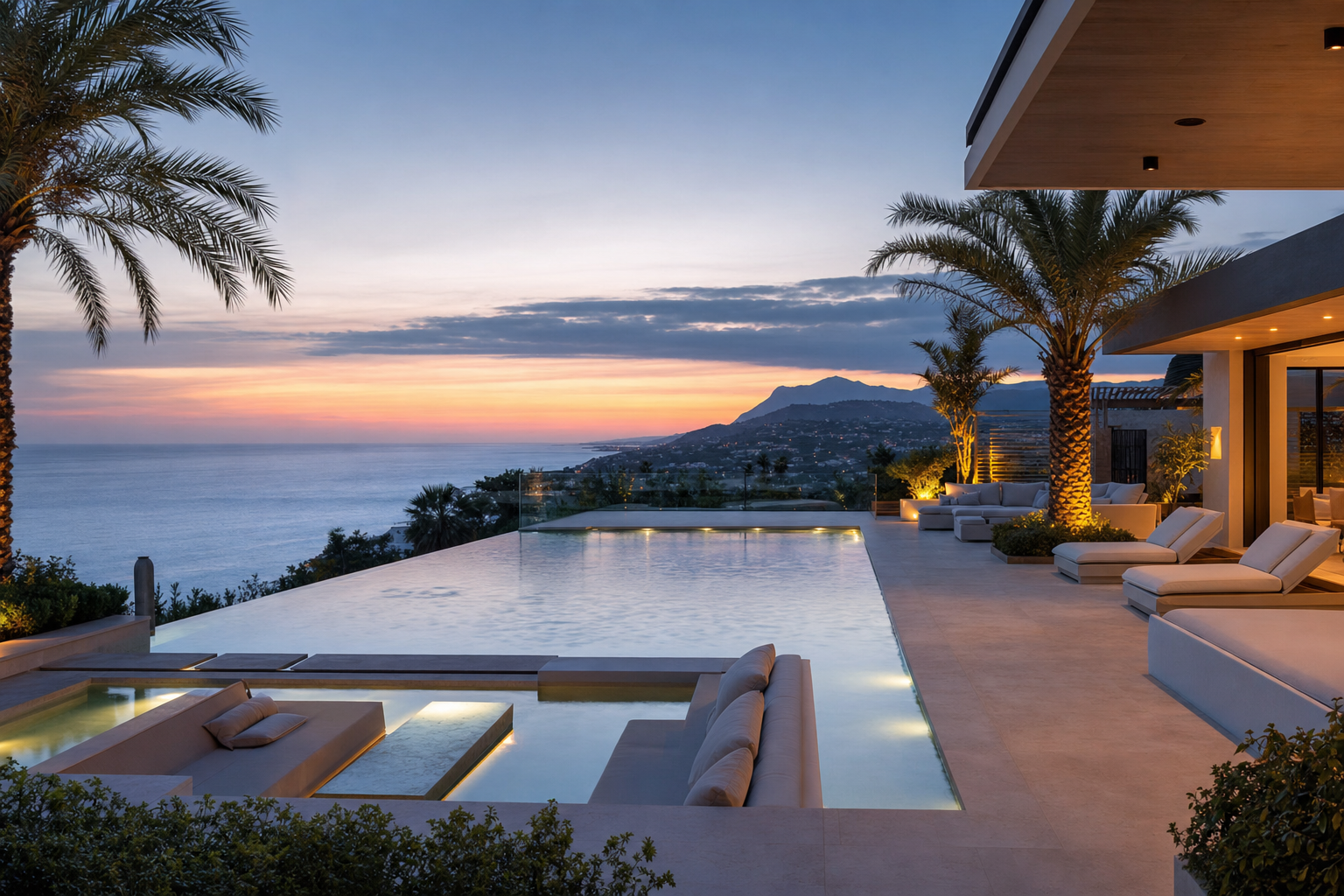
When people ask about the best villa entertaining Marbella has to offer, they tend to mean something specific — a place where the movement between kitchen, terrace, pool and guest suite feels effortless rather than engineered. That quality is harder to find than the listing photographs suggest. A villa can have 800 square metres, a wine cellar and a cinema room and still feel awkward the moment more than eight people sit down to eat. What distinguishes the genuinely entertaining-ready property is a set of spatial decisions made at the design stage that no amount of renovation budget fully corrects after the fact.
What follows is an attempt to describe those decisions clearly, drawn from the desk's work with properties across the Golden Mile, La Zagaleta, Sierra Blanca and Cascada de Camoján.
---
The logic of open-plan living and why most villas get it half right
Open-plan is, at this point, a near-universal selling claim. The reality is more variable. A living area that opens onto a terrace through a single run of sliding glass is open-plan in a technical sense. A space where the kitchen, dining and sitting areas flow into one another without visual interruption — and where the terrace continues that logic rather than interrupting it — is something different.
The distinction matters for entertaining because it determines how a host moves during an evening. In a well-resolved open-plan villa, the person preparing food can hold a conversation with guests at the dining table and still see who is arriving from the terrace. Spatial separation, even partial, creates hierarchies — the kitchen becomes a backstage, the terrace a separate scene. Guests cluster where the sightlines take them and avoid the areas they cannot read.
The villas that handle this best tend to have a single, generous volume on the main floor — typically between 120 and 180 square metres of interior — that opens on two or three sides. Corner plots in Cascada de Camoján and parts of Nueva Andalucía sometimes achieve this naturally. Purpose-built contemporary builds in Sierra Blanca often do it through deliberate glazing strategy, with motorised glass walls that, when fully retracted, leave no perceptible threshold between inside and outside.
What to look for in practice: the absence of load-bearing columns in the living volume, ceiling heights of at least 3.2 metres in the main space, and a terrace that is wide enough — generally 5 metres or more of covered pergola — that it functions as a room rather than a walkway.
---
Outdoor flow: terraces, pool placement and the path between them
The outdoor entertaining sequence in a Marbella villa typically moves from covered dining terrace, to open sun terrace, to pool level, and occasionally to a lower garden. How these zones connect — and how they feel at different times of day — is one of the more overlooked aspects of the property search.
Pool placement is the starting point. A pool set close to the main terrace, ideally within 8 to 12 metres, allows the two areas to feel like a continuous space. Guests can drift between them without the evening fragmenting. A pool set at the far end of a long garden, as is common in some older Golden Mile estates built in the 1990s, creates a spatial break that is difficult to overcome regardless of landscaping.
The orientation of the terrace-pool axis also matters more than it is usually given credit for. A south or south-west facing axis means that the pool terrace retains warmth and light into the early evening, which extends the natural season for outdoor entertaining from April through to late October. In parts of Benahavís and El Madroñal, the elevation — often above 400 metres — introduces an evening breeze that can make south-facing aspects genuinely comfortable through July and August when the coast is not.
Lighting infrastructure is rarely mentioned in viewings but tends to be one of the first things a serious buyer asks about when they begin to imagine actually using the space. Integrated low-voltage path lighting, underwater pool lighting and programmable façade washing are now standard in new builds above €3 million. In resale properties, the quality of the existing lighting installation is a reasonable proxy for how thoughtfully the outdoor space was originally conceived.
---
The chef's kitchen: specification versus reality
The term chef's kitchen has been applied to a wide enough range of kitchens that it has largely lost its meaning. What it ought to describe is a kitchen designed around the simultaneous preparation of multiple courses for a significant number of people — which implies specific things about layout, ventilation, appliance specification and storage.
Layout first. A kitchen designed for serious cooking generally has a clear separation between the prep zone, the cooking zone and the plating or service zone. Island units that double as prep surfaces and informal dining surfaces are a useful feature, but they work best when the main cooking line — hob, oven, extraction — is set back from the island rather than on it. The reason is practical: a host cooking on an island is working directly in front of guests, which suits some people and not others.
Appliance specification worth noting includes induction or gas hobs with at least six burners, double ovens with steam function, a fully integrated refrigeration system (typically a combination of larder fridge, under-counter units and a separate wine climate zone), and extraction powerful enough — generally 1,000 m³/h or above — to clear cooking odours before they reach the living area.
Ventilation is the specification point most commonly compromised in kitchen renovations. A kitchen fitted with a high-specification hob but inadequate extraction will carry cooking smells into every corner of an open-plan villa within twenty minutes of use. In the properties we see across the Marbella register, this is more common than it should be.
Storage depth matters too. A kitchen that looks composed in photographs often reveals itself at a second visit to have shallow units, limited larder space and no dedicated area for large-format serving equipment — the things that actually matter when preparing for a group.
---
Guest wings and bedroom separation
For a villa to function as an entertaining property across a weekend or longer stay, the bedroom arrangement needs to offer genuine separation — between hosts and guests, and between different guest parties if the house is being used for a group with families.
This is where the floor plate of the villa becomes significant. A single-storey villa of 600 square metres can, in principle, accommodate six bedrooms, but if they are arranged along a single corridor they offer almost no acoustic privacy. The most successful entertaining villas tend to have a defined guest wing — either a physically separate pavilion or a bedroom suite cluster accessed from a secondary circulation route — with its own sitting area and, ideally, direct access to an outdoor space.
In La Zagaleta and El Madroñal, where plot sizes regularly exceed 5,000 square metres, fully separate guest houses are common. These allow the main house to function as an entertainment and dining venue while guests have a self-contained retreat. The distinction matters: guests sleeping in a separate structure feel hosted rather than accommodated, which changes the register of the stay.
For urban or semi-urban plots — parts of the Golden Mile, Puerto Banús surroundings, or the hillside streets of Sierra Blanca — full guest houses are rarely possible. Here, the quality of bedroom separation within the main structure becomes the relevant consideration: individual en-suite bathrooms, soundproofing between bedroom walls, and separate external access for the guest suite where the plot permits.
---
Zones that consistently produce the specification
Not all areas of the Costa del Sol produce villas built to this standard in comparable numbers. The concentration of purpose-built contemporary villas with resolved entertaining specifications is highest in a relatively small number of zones.
Cascada de Camoján and Sierra Blanca, immediately above Marbella centre, produce a high density of recently built contemporary villas on controlled plots. The planning regulations and the expectations of the buyer profile in these areas have driven consistent investment in kitchen and outdoor specification over the past decade.
La Zagaleta remains in a category of its own for plot scale and privacy, with the trade-off that architecture varies considerably and some of the original stock from the early 2000s requires significant updating before it meets current entertaining standards.
Nueva Andalucía and the area immediately around Puerto Banús offer a different proposition — smaller average plots but strong indoor-outdoor architecture, proximity to amenities, and a resale market where many villas have been comprehensively renovated in the past five years.
Benahavís and El Madroñal suit buyers for whom altitude, coolness and a degree of distance from the coast are positives rather than compromises. The entertaining logic here leans more toward the private and self-contained than the social and accessible.
---
What the viewing rarely shows you
A property viewed on a Tuesday morning in March does not reveal how it behaves at nine in the evening in July with sixteen people present. The spatial logic described above — flow, separation, ventilation, acoustic performance — only becomes fully legible when the house is in use.
This is one reason why the second viewing, at a different time of day and ideally with some deliberate movement through the space — standing at the hob, walking the path between kitchen and pool terrace, sitting at the far end of the guest wing — tends to produce a more reliable picture than the first. The villa that holds up under that kind of quiet, methodical attention is usually the one that holds up under actual use.
The best entertaining villas in Marbella are not always the largest or the most recently completed. They are the ones where someone, at the design stage, thought through the sequence of an evening — where the food comes from, where the guests move, where they end up — and built the answer into the structure of the house.