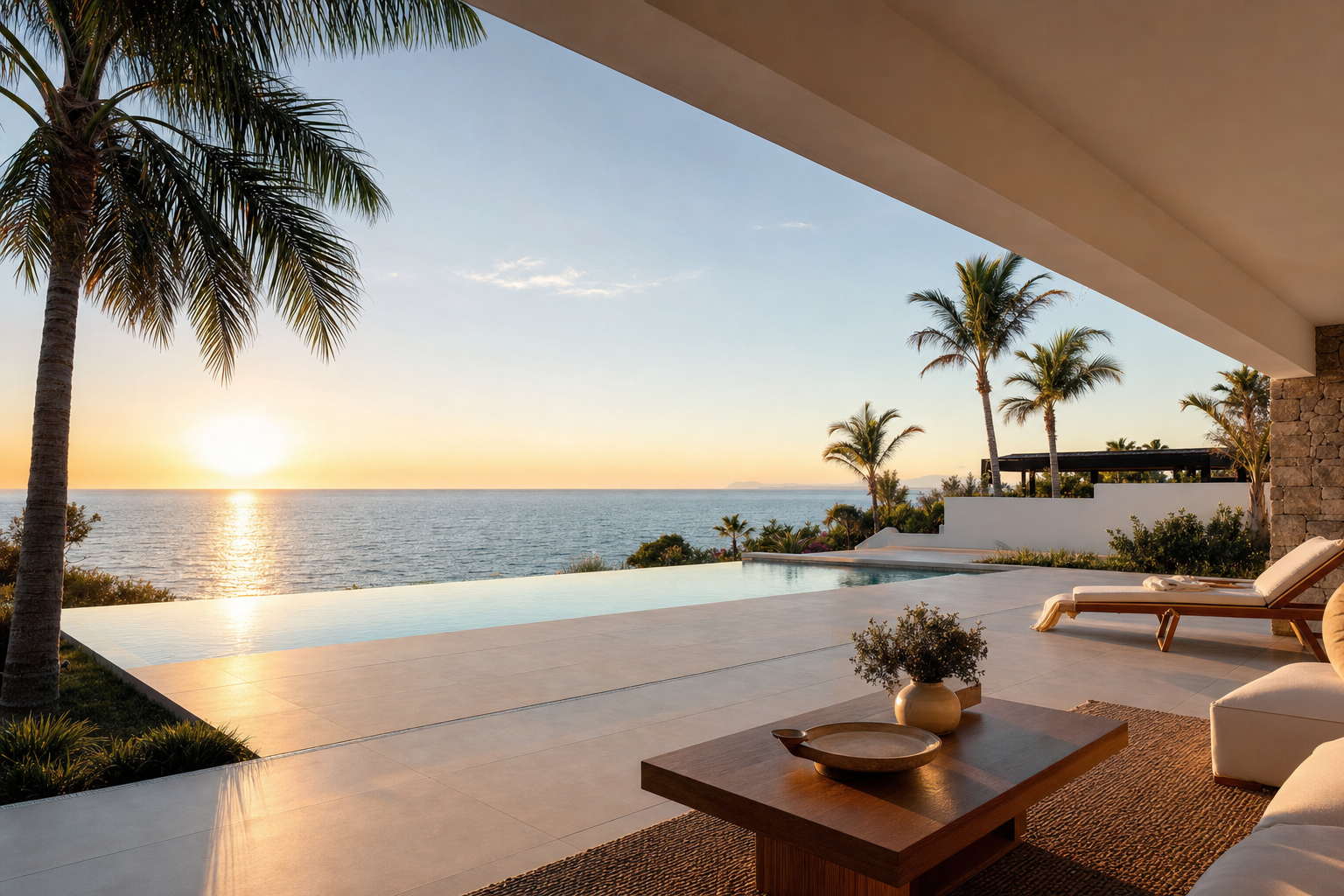
The Estepona New Golden Mile runs west from San Pedro de Alcantara along the A-7 coast road to Estepona town — approximately 18 kilometres of seafront and hillside development, and one of the places where new-build delivery on this coast is concentrated.
The two zones ask differently: the asking medians for the corridor and for the Marbella Golden Mile proper, each with its sample size and date, are on the Marbella Property Index (museselection.es/marbella-property-index). What either would complete at is published nowhere in Spain. Buyers aware of both markets keep asking whether the difference is justified by anything other than postcode.
Our view: for many of the buyers we work with, it is not. The same Andalusian sun, the same access to Puerto Banús (15 to 22 minutes by car), the same international school corridor — at a price that reflects the relative youth of the address rather than a material difference in quality of life.
What the New Golden Mile genuinely lacks is the brand density of the Marbella Golden Mile: the Marbella Club, Puente Romano, the social circuit that three generations of UHNW buyers have used as a reference point. For buyers who need that infrastructure — who will use the Marbella Club spa twice a week and want to walk to Nobu — the Golden Mile premium is probably worth it. For buyers who want the sea, the sun, a well-specified new home, and proximity to everything without paying for an address they rarely need, the New Golden Mile is the stronger financial case.
Estepona town itself has become a destination — a genuinely pleasant old town with a functioning marina, quality restaurants, and a Saturday market that has nothing to do with tourist Marbella. The zone is no longer a western appendix to a more established address; it stands on its own.
New-build supply is still entering the market on the New Golden Mile, which means buyers have choices that are scarcer elsewhere on the coast: contemporary specification and customisation windows. New developments are built to current energy-performance standards, with solar, underfloor heating, aerothermal systems and EV charging — practical operating-cost advantages over a 30-year-old villa regardless of the purchase price.
The practical buying question on this corridor is timing. Several developments are delivering in late 2026 and early 2027. A developer's price list usually rises between launch and completion, and nobody can put a percentage on what that is worth, because the completions behind it are unpublished. Ask for the current list, the delivery date in the contract and the bank guarantee on the deposit.