They tend not to announce themselves. No broker relationship cultivated over a long lunch, no competitive bidding driven by fear of missing out. German buyers arrive having done the reading. By the time they sit across a table, they already understand the tenure structure, the community fees, and what the zone is currently asking.
That character is not incidental. It shapes where they buy, how they buy, and why the cohort is so steady.
Who is buying, and where
In the desk's own enquiries — an observation, not a count; no public dataset records buyer nationality at this price level — the profile skews older than the Scandinavian or British one: broadly, principals in their late forties through sixties, often with established businesses in Germany or Austria, sometimes with a prior property holding in Switzerland or Mallorca. The Marbella decision is rarely impulsive. It typically follows several years of winter visits, a period of rental use, and a deliberate narrowing of options.
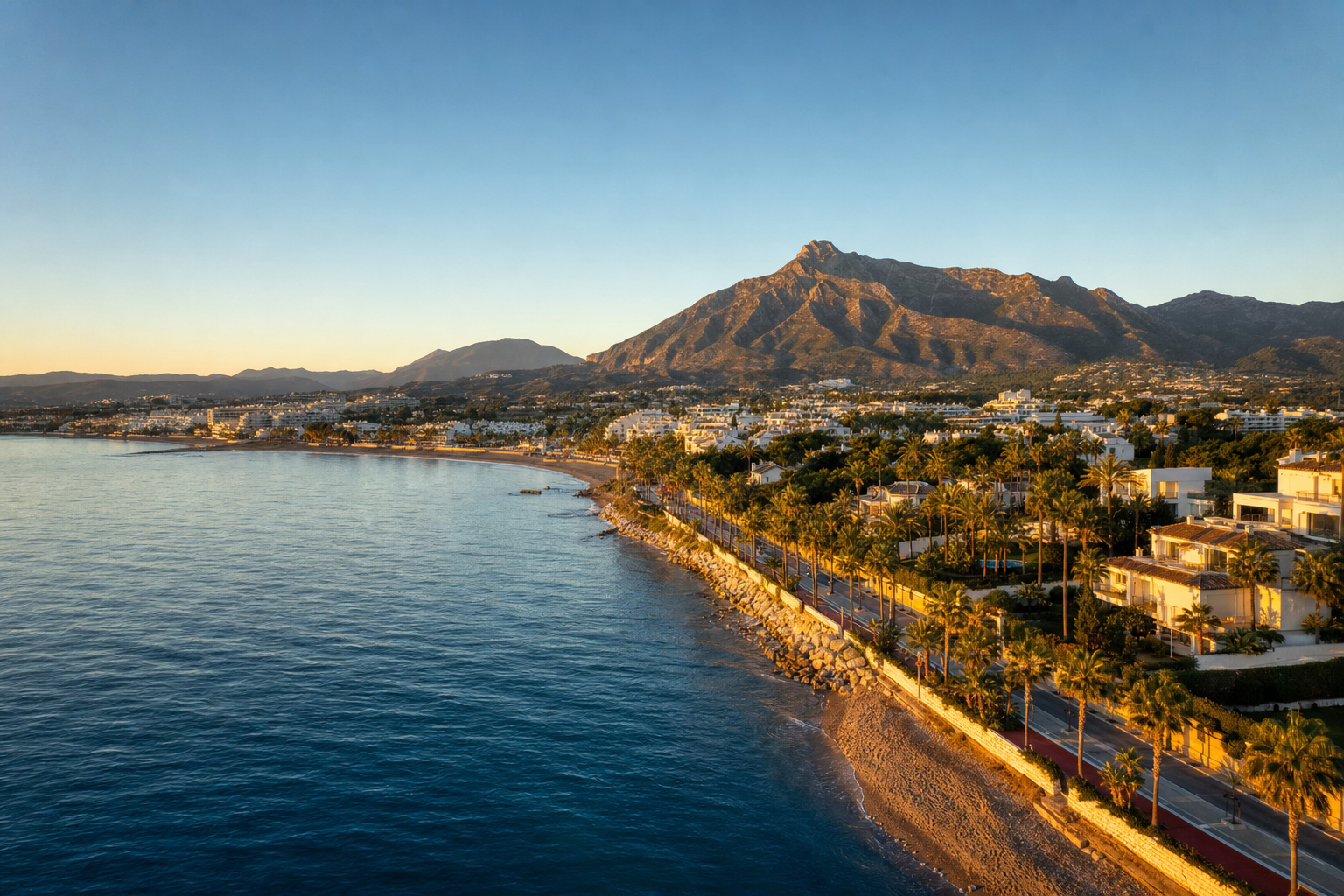
Geographically, the concentration is clear. Sierra Blanca — roughly 300 residences on the southern slope of La Concha, around 300 metres above sea level — draws much of the German interest. The gated structure, the elevation, the sightlines, and the relative privacy all register as correct to a buyer who has usually come from a similarly ordered residential environment in Munich, Hamburg, or Frankfurt.
The Golden Mile is the other primary zone. Four kilometres of coastline between Marbella and Puerto Banús, around 800 residences. Current asking prices by zone, each with its sample size and date, are on the Marbella Property Index (museselection.es/marbella-property-index). What German buyers tend to read into the axis is not a price curve — no one can draw an honest one, since Spain publishes no completed sales — but the fact that people who bought here before them did not leave. The names on the street change slowly. That is the observation, and it is worth more to this cohort than a chart would be.
The structural case, as they see it
German buyers are not, as a rule, yield-seekers. The acquisition is typically a lifestyle decision with a considered wealth-preservation dimension — not a return-maximising one. Marbella's structural arguments map onto that framing reasonably well: stable supply in the upper zones, constrained planning in the established gated communities, and a buyer base that has not historically been forced to sell. What those arguments cannot be paired with is a price history, since Spain records none — so the case rests on the supply constraint, which is at least observable from the road.
Where Spanish residential pricing at the top end has actually gone over time is not answerable from any public record, and the desk does not pretend otherwise. What the register shows is the level being asked now, zone by zone, on the Marbella Property Index. La Zagaleta — a 9 km² private estate above Benahavís with two golf courses and a heliport — is a different category entirely, and it enters the German buyer's consideration set once the budget extends to the top of the register. Few of its about 230 plots are publicly catalogued at any one time, which tells its own story: the assets that matter in that zone rarely reach a listing platform. For buyers who prefer discretion, that is not a problem. It is the point.
Tax and the Spain–Germany treaty
The practical fiscal picture is well-defined. Spain and Germany have a double taxation agreement that has been in force for decades, and its operation is broadly understood by German tax advisers who work with clients holding cross-border assets. The treaty allocates taxing rights over rental income and capital gains to the country of source — Spain — meaning that a German resident owning a property in Marbella pays Spanish tax on any Spanish-source income or gain, with credit against the German liability. For buyers who do not intend to rent, and whose primary exposure is the annual Impuesto sobre Bienes Inmuebles (the municipal property tax) plus the non-resident wealth tax where applicable, the filing obligations are manageable.
The full picture of ongoing costs — IBI, community fees, non-resident income imputation if the property is not rented — is worth reviewing carefully before completing a purchase. A thorough walkthrough of [how Spanish property taxes apply to non-resident buyers](/guides/spanish-property-tax-2026) is the appropriate starting point for any German principal at early stage.
The Beckham regime — a tax regime for people who move to Spain for work, not a visa — has attracted attention across northern Europe, though German buyers at this price point are typically not relocating their tax residence — they are acquiring a secondary or tertiary property while remaining fiscally German. The distinction matters: the purchase structure, the applicable taxes, and the ongoing compliance obligations differ considerably between those two cases.
The NIE process from Germany
Every property purchase in Spain requires a Número de Identificación de Extranjeros — the NIE. For German buyers, the process can be initiated without travelling to Spain, which is practically useful for principals with constrained schedules.
The Spanish consulates in Berlin, Munich, Frankfurt, Hamburg, and Düsseldorf all handle NIE applications. The standard route requires a completed EX-15 form, a valid passport with copies, and proof of the purpose of the application — typically a promissory purchase contract or a letter from a Spanish solicitor outlining the intended transaction. Processing times vary; allow two to six weeks, depending on the police station or consulate and on whether a lawyer applies under a power of attorney.
Alternatively, the buyer can grant power of attorney to their Spanish solicitor, who processes the NIE directly in Spain — often more efficiently, particularly when the purchase timeline is compressed. In our experience, most buyers at this price level opt for the power of attorney route once they have appointed counsel, as it removes the consulate queue from the critical path entirely.
Cash, financing, and a modest shift
German buyers are, in the desk's experience, notable within the Marbella market for a strong preference for cash transactions. The instinct is cultural and practical in roughly equal measure: an aversion to leverage on assets intended as wealth stores, a preference for clean, unconditioned offers, and — historically — limited appetite for the friction involved in obtaining a Spanish mortgage as a non-resident.
That pattern is real, but it is softening at the margin. Some German buyers in the €2M–€5M range now engage with Spanish private banking financing, particularly where capital is deployed elsewhere and the cost of releasing it is not trivial. It remains a minority approach within this cohort.
At the top of the register, cash remains the norm in the desk's experience. The buyer moving at that level is not constrained by capital availability; the all-cash position is a negotiating instrument as much as a financial preference.
Schools and long-term anchoring
One dimension that does not always appear in buyer analysis but matters practically: schooling. German families considering any extended presence — or contemplating a future primary relocation — run Deutsche Schule Málaga as the first reference. The school has a long history in the city and delivers the German curriculum through to Abitur, which is the credential that matters for a family intending to maintain optionality about returning to Germany or entering a German university system. For families willing to consider Sotogrande — roughly 44 minutes west of Marbella by the A-7 — Sotogrande International School offers a well-regarded IB programme within a campus that has developed its own long-standing community of international families.
Schooling is rarely the sole driver of a location decision at this price point, but it functions as a constraint. Buyers who require a specific school calendar or language programme narrow their viable zones considerably, and it is worth establishing that parameter early rather than late in the search.
The 2026 picture
Nothing in the desk's own enquiry flow suggests German interest in Marbella has slowed entering 2026. The broader European luxury sentiment shift — visible in some auction categories and in parts of the French Riviera market — has not reached the top of the Marbella register in any form we can observe. That is an observation from our own book rather than a market statistic; for Spain, no statistic of that kind exists to check it against.
The reasons are structural rather than cyclical. Established gated communities in Marbella are not building significant new supply. The buyer who wants Sierra Blanca or the upper Golden Mile is competing for a finite stock, some of which is never advertised — and no one, this desk included, can quantify how much. The practical consequence is what matters to German buyers: a market of this shape rewards preparation and relationships over opportunistic searching.
The cohort's patience, in other words, is not a liability in this market. It is a reasonable strategy.