On the evening of 23 May, the Centro Polivalente de Nueva Andalucía will host sixty fighters across thirty amateur and professional bouts, with an Andalusian title at stake in the K1 and Muay Thai disciplines. The event was organised locally, draws participants from across the region, and takes place in a municipal facility that most residents of Nueva Andalucía can reach on foot. That last detail is not incidental.
It is worth pausing on what an event like this actually signals about a neighbourhood. Not the combat sport itself — though Muay Thai and K1 have a serious, technically demanding following in southern Spain that deserves more than a passing mention — but the infrastructure that makes it possible. A polivalente, a multipurpose civic centre, is a certain kind of urban commitment. It says that the people who planned this quarter anticipated that residents would want to do things here, not merely sleep here between trips elsewhere.
Nueva Andalucía as a Working Neighbourhood
Nueva Andalucía sits immediately west of Puerto Banús, bounded loosely by the AP-7 to the north and the coastal strip to the south. Within those borders it contains the Real Club de Golf Las Brisas, the Aloha Golf Club, the Golf Valley in its entirety, a functioning commercial street along the Avenida Julio Iglesias, supermarkets, schools, clinics, and the Centro Polivalente itself. This density of amenity is not accidental. Nueva Andalucía was developed incrementally from the late 1960s onward, which gave it time to accumulate the kind of ordinary infrastructure that purely residential developments rarely achieve.
For buyers evaluating the zone, this completeness matters in ways that are difficult to price but not difficult to observe. A household that intends to live in Marbella rather than visit it periodically requires different things from its address than one that will occupy a residence for six weeks a year. Schools within walking distance, a civic centre hosting regional sporting events, a covered market — these are the markers of a neighbourhood that has earned its density rather than simply been designated one.
Nueva Andalucía's housing stock runs from townhouses within established urbanisations to detached villas with Golf Valley frontage and contemporary renovation. That breadth reflects genuine variety in the housing stock, not market incoherence. Current asking prices by zone, each with its sample size and date, are on the Marbella Property Index (museselection.es/marbella-property-index).
The Golf Valley and Its Northern Gradient
The Golf Valley label applies to the residential area flanking the three golf courses — Aloha, Las Brisas, and Los Naranjos — and it functions as a micro-market within the broader Nueva Andalucía designation. Properties here tend to sit on larger plots, often between 1,200 and 3,000 square metres, and the architectural vocabulary ranges from 1980s Andalusian vernacular to fully contemporary builds completed in the last five years.
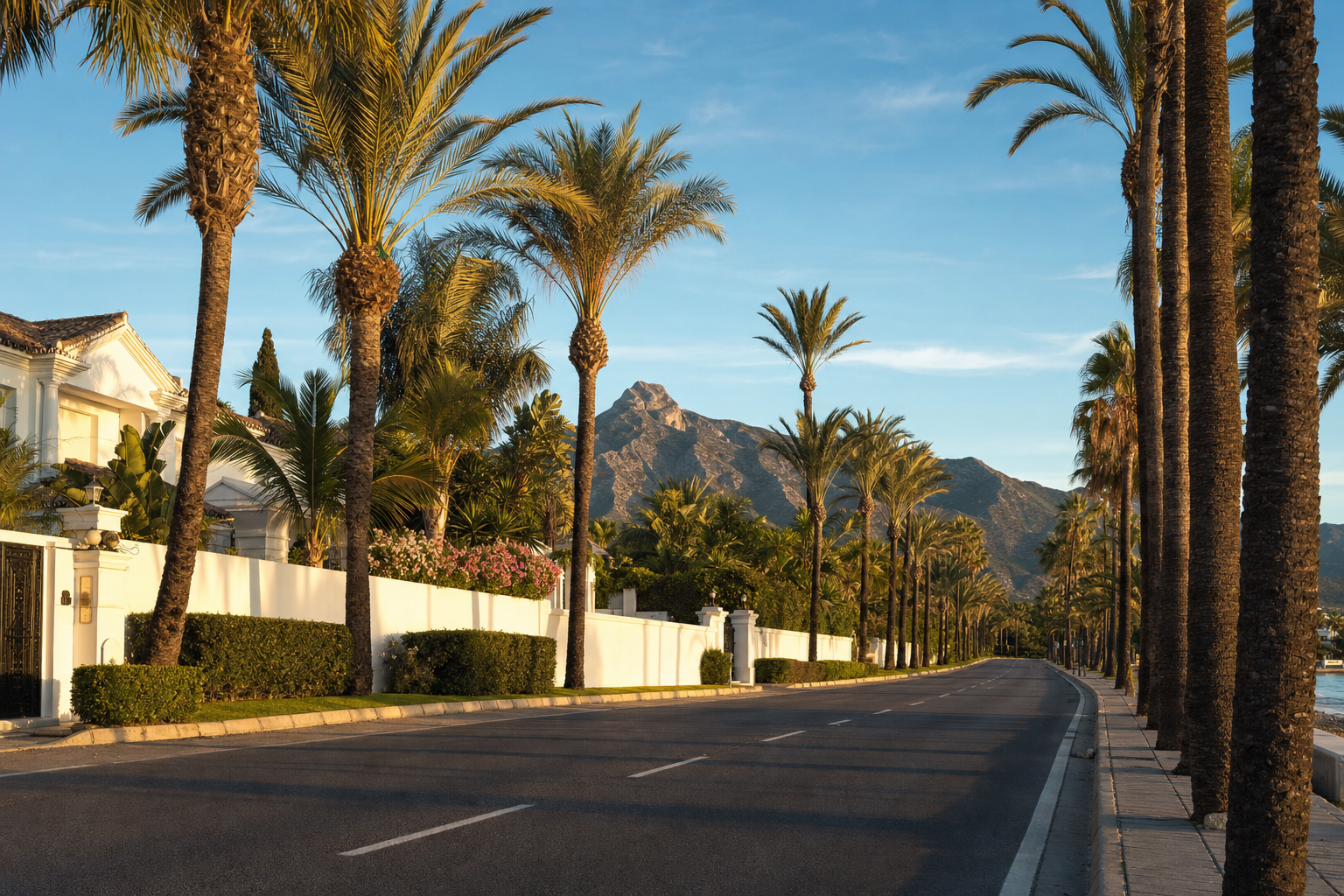
What the Golf Valley offers that most of the Costa del Sol cannot replicate is a combination of altitude and greenery that produces a genuinely different micro-climate. Summer evenings here are measurably cooler than on the coastal strip two kilometres south. Mature umbrella pines, established gardens, and the visual buffer of the fairways create an environment that reads as secluded without being remote. The Centro Polivalente is fifteen minutes on foot from the northern edge of the Valley; Puerto Banús harbour is twelve minutes by car.
Some residences are not published and are shown by introduction. In this zone the detached villas with south or southwest orientation, pools of 50 square metres or more, and independent guest accommodation are the ones whose owners most often prefer to transact privately.
What Civic Life Tells Buyers About Resale Dynamics
There is a less obvious connection between events like the 23 May velada and the medium-term behaviour of property values in a given neighbourhood. Zones that sustain active civic programming — sports events, cultural gatherings, markets, school functions — tend to maintain rental demand from resident populations rather than purely from short-term tourist flows. That distinction has become more consequential since the Junta de Andalucía and Marbella's ayuntamiento began tightening the conditions under which tourist rental licences are granted and renewed.
Under current Andalusian regulations, properties in zones classified for residential rather than tourist use face increasing scrutiny when applying for new VFT (Vivienda con Fines Turísticos) licences. The practical implication is that investors purchasing in Nueva Andalucía today should model their returns against long-term residential rental demand rather than assuming the tourist rental channel will remain as accessible as it was between 2018 and 2023. This is not a pessimistic reading — long-term residential demand in Nueva Andalucía is structurally sound — but it requires a different analytical frame than the yield calculations that drove much acquisition activity during the post-pandemic surge.
A neighbourhood that holds regional sporting championships on a Thursday evening in May is a neighbourhood with residents who intend to stay. That underlying stability is the correct variable to weight when projecting a five-year hold.
Architectural Character and the Question of Renovation
Nueva Andalucía's housing stock presents a renovation question that buyers encounter frequently and should understand clearly before committing. A substantial portion of the detached villas in the Golf Valley and the surrounding urbanisations — La Quinta, Las Lomas del Marbella Club, Marbella Country Club — were built between 1975 and 1995. Many have not been substantially updated since original construction. They offer generous volumes, good plot sizes, and mature landscaping, but their mechanical systems, glazing, and interior finishes require complete replacement to meet contemporary expectations.
The cost of a full renovation in this zone, engaging architects and contractors with the relevant experience and the correct planning permissions, runs €1,500-€3,000 per m² for full interior renovation as a working range from the desk's current projects, not as a quote; structural and facade work adds more. Take a builder's quote on the actual villa. This figure is not commonly disclosed in sale particulars, which tend to present purchase price in isolation.
Buyers who absorb this calculation correctly will understand that a villa offered at €1.8 million requiring full renovation is not necessarily cheaper than one offered at €2.7 million in finished condition. The question is always total cost of ownership at the point of occupancy, and in Nueva Andalucía that calculation is more variable than in zones where the housing stock is newer and more uniform.
The Relationship Between Proximity and Permanence
Marbella as a whole has been reshaping its residential identity over the past several years. The Golden Mile, Sierra Blanca, and Cascada de Camoján attract buyers seeking maximum prestige and privacy. La Zagaleta and El Madroñal serve a buyer for whom security and scale are primary. These zones have their own coherent logic.
Nueva Andalucía occupies a different position in that hierarchy — not lower, but differently oriented. Its buyers are more likely to be primary or secondary residents with genuine ties to the area: families using the international schools nearby, individuals who train seriously and value access to good facilities, professionals who intend to work remotely and need reliable infrastructure around them. The Centro Polivalente hosting a regional Muay Thai championship is, in this reading, a data point about who actually lives here.
That demographic has proven resilient through market cycles, though the sentence has to stop short of a measurement: Spain publishes no per-property record of completed sales, so nobody can compare transaction volumes between this district and any other, in this cycle or the last. What the combination of accessible price entry, genuine amenity and the organic civic life visible in events like the 23 May velada does produce is a market with a broad, resident buyer base rather than a purely speculative one — which is a description of who is buying, not a forecast of what they will earn.
A Note on the Event Itself
Sixty fighters, thirty bouts, an Andalusian title. The Centro Polivalente will be full on 23 May. People will travel from across the province to compete and to watch. Afterwards they will eat in Nueva Andalucía, drink coffee on the Avenida Julio Iglesias, and some will pass by the Golf Valley on their way back to wherever they have come from.
This is how a place accumulates meaning that is independent of its property listings. The real-estate consequences are secondary to the human fact: a neighbourhood that generates this kind of activity is one in which people have chosen to invest their time and identity, not merely their capital. The distinction, in the long run, tends to matter more than most buyers initially expect.
For those currently evaluating Nueva Andalucía as a residential commitment, the appropriate question is not whether a given villa meets a checklist of specifications, but whether the neighbourhood around it corresponds to the life they intend to live. On the evidence of what is happening there on a Friday evening in late May, the answer, for a particular kind of buyer, is yes.