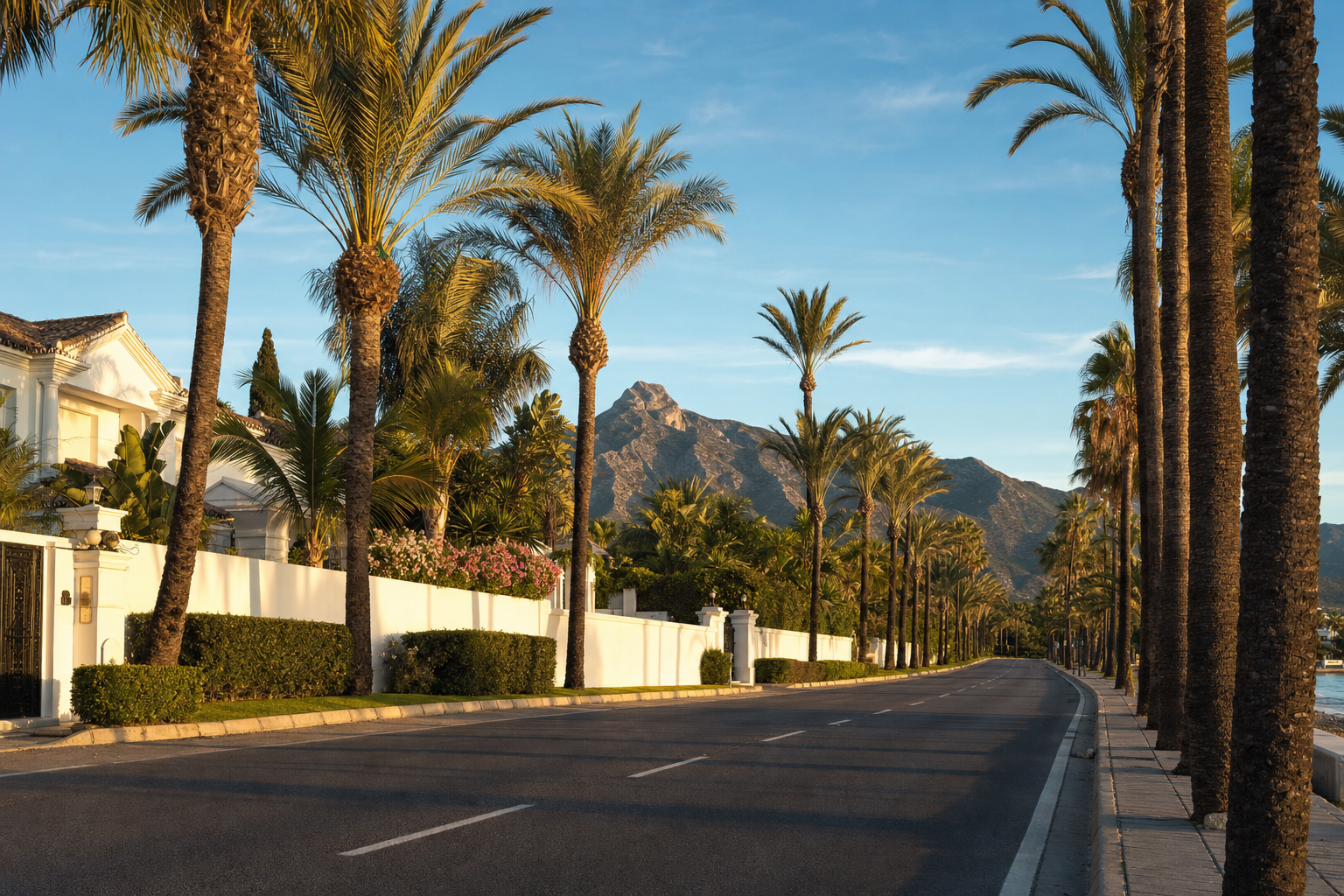
A Port That Has Always Traded on Its Address
Puerto Banús opened in 1970, the personal project of José Banús, on a strip of coastline that most people at the time regarded as remote. Within a decade it had become one of the most recognisable marina addresses in Europe. That reputation was built on a particular mix: deep-water berths large enough for serious yachts, a frontline promenade calibrated for pedestrian theatre, and proximity to Marbella's Golden Mile without actually being Marbella centre. The formula held for fifty years.
What it did not do particularly well, for much of that time, was renew itself. That is now changing on the public record. Puerto Banús (Puerto José Banús) is run by its concession holder, Puerto José Banús, S.A., under an administrative concession of the Junta de Andalucía (Agencia Pública de Puertos de Andalucía), extended to 3 October 2066. The notice, published in the Junta's official gazette on 9 May 2025 (BOJA núm. 87), records a substantial modification of the concession together with the extension of its term.
Understanding what that means for puerto banús redevelopment property prices requires separating the credible from the speculative, and being honest about timelines that, in Andalucían infrastructure terms, rarely move as announced.
What Is on the Record, and What Is Not
The gazette notice records the extension and the concession holder. It does not set out a works programme, a berth plan or a residential component, and this desk has not seen a published document that does. What circulates locally — improved mooring and service facilities, a refreshed commercial strip along the quay, wider promenades and better vehicle access at the port entrance — is the kind of programme a long concession makes possible, not a schedule anyone can hold the port to.
A buyer should therefore treat any dated timeline, any count of new berths and any description of new residential units beside the port as unconfirmed until the concession holder or the Agencia Pública de Puertos de Andalucía publishes it. Ask the selling agent for the document, not the summary.
How Port Investment Reaches Nearby Property
Property around a marina responds to investment through its surroundings rather than through a formula. While works are under way, addresses with a direct view of a construction site are harder to enjoy and harder to resell; once works are finished, what matters is whether the result delivers what was promised.
What cannot be supplied is a percentage. No appreciation or year-on-year figure exists for these addresses: it would need closing prices at two dates, and Spain publishes none. Figures quoted for the uplift at other marinas are estimates, and the desk does not forecast.
The Zones Most Directly Affected
Not all addresses near Puerto Banús are equally positioned to capture price movement from the redevelopment.
The most directly affected zone is the frontline and first-line promenade itself, along and immediately behind the Muelle de Ribera. Apartments with direct port views in the existing residential buildings — many of them dating from the 1980s and 1990s — often need updating, and the port environment around them has felt tired. As the environment improves, the gap between location and asset condition becomes more visible, which tends to attract buyers who are comfortable with refurbishment.
The second zone of interest is Nueva Andalucía immediately to the north, particularly the streets within comfortable walking distance of the port entrance. This area has its own pricing logic tied to golf and the residential density of the valley, but its accessibility to the port is an underappreciated factor.
The Golden Mile, running east toward Marbella centre, is less directly exposed to the port redevelopment but benefits from the general elevation of the area's profile that a successful marina repositioning tends to produce. Sierra Blanca and Cascada de Camoján, being elevated and inland, are affected mostly through the second-order channel of overall Marbella desirability rather than any direct proximity effect.
What the Register Can and Cannot Show
The register we maintain at Muse Selection records asking prices, and only asking prices.
What the market cannot tell you is the discount buyers are actually achieving. Discount bands are quoted constantly on this coast and every one of them is invented, because the closing price that would anchor the calculation is not published anywhere in Spain. Current asking prices by zone, each with its sample size and date, are on the Marbella Property Index (museselection.es/marbella-property-index).
In the desk's own enquiries — an observation, not a count — more buyers looking at port-adjacent properties now mention the redevelopment in their first conversation rather than arriving at it as incidental information.
The Risks That Deserve Honest Acknowledgement
A piece about Puerto Banús redevelopment and property prices that did not address the risks would be incomplete.
The primary risk is execution and delay. Large infrastructure projects on the Costa del Sol have a long history of running significantly over timeline and, occasionally, of being partially completed and then stalled by changes in municipal administration, funding shortfalls, or legal challenges from affected parties. A buyer pricing in a completed-development scenario should hold the assumption loosely and ensure that the underlying property makes sense at current values regardless of whether the redevelopment proceeds on schedule.
The secondary risk is paying for a story. When a redevelopment becomes widely discussed, sellers price it in before a single work is finished. Buyers expecting gains on the back of news flow alone may be disappointed.
The tertiary risk is construction disruption. As noted above, properties with direct construction exposure will face a period of reduced enjoyment and likely suppressed resale liquidity during the active works phase. For buyers who need or want optionality in the short term, that is a real constraint.
An Observation Rather Than a Conclusion
Puerto Banús has always been somewhat resistant to easy categorisation. It is not Monaco, not Portofino, not a quiet Balearic anchorage. It is a particular kind of place — conspicuous, commercial, occasionally exhausting, and yet possessed of a site quality that no amount of dated infrastructure can fully negate. The water is the same water. The mountains behind it are the same mountains. The light on the port at seven in the evening has not changed.
What the redevelopment represents, if it proceeds as planned, is an attempt to bring the built environment back into alignment with what the site has always offered. Whether it succeeds fully, partially, or not at all is not something anyone can know today. That uncertainty is the honest condition under which anyone buying in the zone right now is operating. Acknowledging it seems more useful than pretending otherwise.