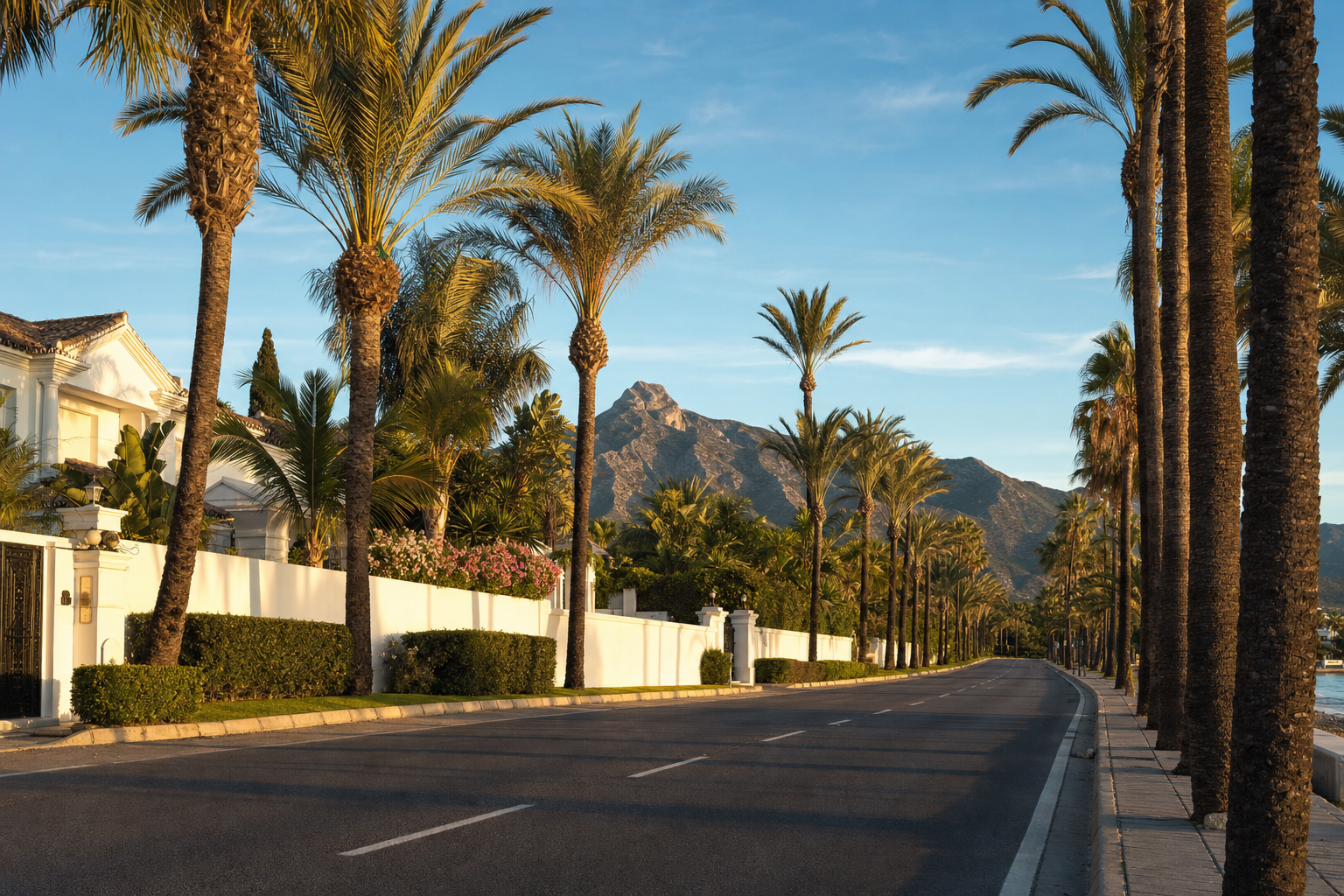
The AP-7 runs along the coast, and most people never leave it. Marbella pulls them east or west, Puerto Banús offers a turn-off, Estepona eventually resolves the journey. Benahavís is the municipality that sits behind all of that — uphill, inland, older by several centuries than the resort culture it now partially hosts.
The white village itself, the pueblo blanco that gives the municipality its name, predates the Costa del Sol as a tourism phenomenon by a considerable margin. Cortijo culture, olive groves, a river gorge: this was agricultural and defensive country long before the first marina was dug into the coast below. That history does not make Benahavís quaint. It makes it distinct.
What the municipality actually contains
Benahavís is large by local standards — a sprawling municipal territory that runs from the coastal highway up through several hundred metres of elevation gain before the land flattens into high plateau. Within that territory sits an unusual concentration of private residential estates. La Zagaleta occupies nine square kilometres above the village proper: about 230 plots, two private golf courses, a helipad, and a preference for private sale: some residences there are not published and are shown by introduction. El Madroñal sits at a comparable elevation, smaller in scale, similarly orientated toward privacy. Marbella Club Golf Resort, La Quinta, and Capanes del Golf occupy the lower and mid-elevation bands, each with its own character and price range, each gated.
The effect, when you map it, is of a layered residential system — successive tiers of enclosure as the road climbs, each tier offering something the one below it does not. Altitude. Silence. Distance from the coast road's noise. The buyers who end up here are not, by and large, buyers who arrived intending to be inland. They arrived intending to be private, and the geography accommodated them.
The Zagaleta fact
Most serious conversations about [Benahavís luxury villas](/districts/benahavis) eventually arrive at La Zagaleta, and it is worth being precise about what the estate represents rather than what it is often made to represent. It is not simply the most expensive address in the zone. It is a functioning private community with its own internal logic: road infrastructure, equestrian facilities, a level of security that is operational rather than decorative. Its residences change hands rarely, and how rarely is not something anyone can count: Spain publishes no per-property closing prices, so a trade tally for the estate would be guessed rather than measured. What can be shown is what is asked. Current asking prices by zone, each with its sample size and date, are on the Marbella Property Index (museselection.es/marbella-property-index) — and for La Zagaleta the sample is thin enough that the index prints its size so that nobody mistakes it for a market.
The helipad is not incidental detail. A meaningful share of Zagaleta owners do not arrive by road at all, or arrive by road only when they choose to. The connection to the coast — Puerto Banús is typically fifteen to twenty-five minutes depending on where within the estate you begin — exists, but it is not the primary relationship the estate has with geography. The primary relationship is vertical: above the cloud line on certain mornings, with the Mediterranean visible and the coastal noise entirely absent.
El Madroñal and the smaller estates
El Madroñal occupies a quieter position in the market conversation, which is consistent with what it is: a smaller, less structured estate at similar elevation, with plots and villas that tend toward the cortijo aesthetic rather than the contemporary glass-and-steel vocabulary that dominates new builds further downhill. Buyers here are often making a conscious choice against visibility. The architecture does not announce itself. That is the point.
Capanes del Golf and La Quinta sit lower, closer to the coast road, and function more as golf-adjacent communities than as privacy estates in the Zagaleta sense. They are not interchangeable with the upper tiers, but they serve a buyer who wants the mountain air, the green setting, and a manageable drive to Puerto Banús without the price floor that the upper estates impose. Marbella Club Golf Resort carries its parent brand's associations — a certain formality, a long-established membership culture — and draws buyers for whom that continuity of character matters.
The buyer profile
There is a pattern in who acquires in Benahavís that is legible once you have seen it across enough enquiries. These are not buyers who arrived on the Costa del Sol for the beach and upgraded. They are often buyers who evaluated the Golden Mile, understood what it offered, and made a deliberate turn inland. The trade is explicit: less immediate access to the shore, more immediate access to solitude. Olive grove rather than beach club. Helicopter pad rather than marina berth.
Nationally, the profile in the desk's own enquiries is diverse — an observation, not a count: northern European buyers with long Marbella histories, Middle Eastern families for whom compound-style privacy is a baseline requirement rather than a premium, and an increasing number of buyers from the Americas who arrive with California or Miami references and find the mountain setting more legible than the beachfront strip. What they share is a preference for acreage, for the kind of space that is simply unavailable at sea level, and for the particular quality of light and temperature that elevation on this stretch of the Andalusian coast provides.
The cortijo thread
It is worth pausing on the cortijo culture, because it is not merely atmospheric colour. The cortijo — the working Andalusian farmhouse, typically organised around an internal courtyard, built for heat management and animal husbandry rather than view maximisation — established an architectural and spatial grammar in this territory that predates the resort era by several centuries. Some buyers in Benahavís are consciously working within that grammar: commissioning architects who understand the thick wall, the shaded loggia, the water element at the centre of the plan. Others are working against it, importing a contemporary vocabulary onto plots that the land absorbed in an earlier idiom.
Neither approach is wrong. But the buyers who engage with the cortijo tradition tend to arrive with a different kind of attention to what they are acquiring. They are buying into a landscape that has been cultivated, in the agricultural sense, for a very long time. That continuity is part of the value proposition, even when it is not articulated as such.
What the market is doing
No one can put a percentage on how much of the upper Marbella register changes hands without ever being published — an instruction that is never listed is never counted, and every off-market share figure in circulation is constructed rather than measured. What the desk observes in Benahavís, and in La Zagaleta particularly, is a private route used more consistently than on the coast below. This is not accidental. It reflects the preference of sellers who do not need to list publicly, and buyers who have learned that the interesting inventory does not always appear on the platforms. The practical consequence for a first-time buyer in this zone is that the visible market is a partial picture. In our experience, the gap between what is listed and what is available is wider here than in almost any other zone on the coast.
Cascada de Camoján, which sits on the Marbella side of the boundary but shares the elevated, privacy-orientated character of the Benahavís upper estates, offers a useful comparison point: three elevation tiers, with elevation and plot size doing most of the work in what is asked. The Benahavís upper estates operate within a comparable logic.
The inland inversion
For much of the Costa del Sol's modern history, value ran along a single axis: proximity to the water. The Golden Mile commanded its premium because of what it fronted. Benahavís represents something like an inversion of that logic — not a rejection of the coast, but a reordering of the hierarchy. The sea is visible from most elevated positions in the municipality. It is simply not the primary reason to be there.
That inversion has been underway for some time, but it has accelerated. The buyers who are most active in the Benahavís upper estates at present are not making a compromise. They are making a preference statement. The mountain, on a clear morning above the cloud line, with the Mediterranean below and nothing audible except whatever wind is moving through the cork oaks, makes the case for itself without assistance.