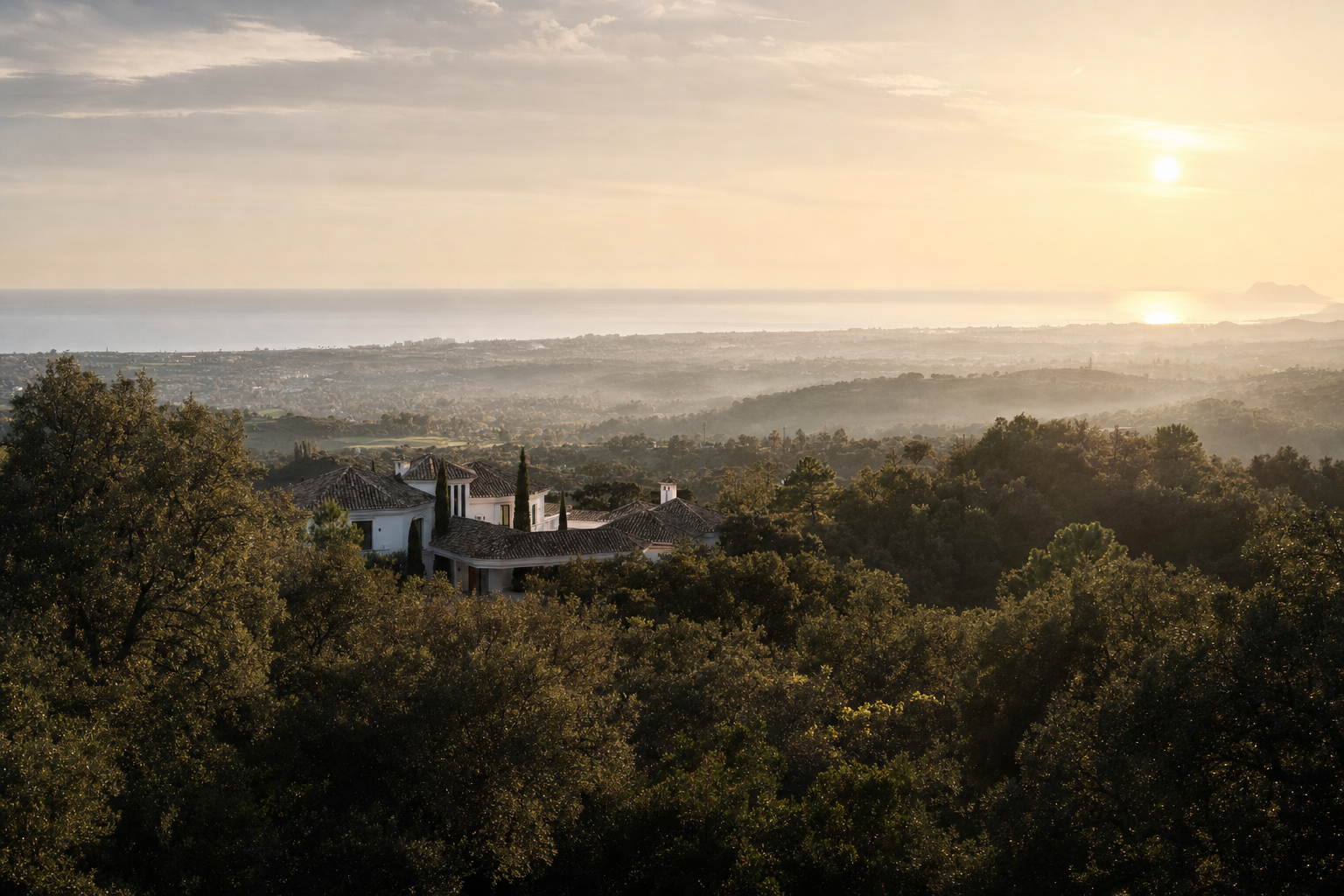
Drive west out of Marbella on the A-7 and the density falls away noticeably within ten minutes. The apartment towers thin. The beach widens. By the time you pass Cancelada and approach central Estepona, the register has shifted entirely — less curated, less trafficked, more open to the sky. This is the New Golden Mile, and the name is partly aspirational, partly earned. It is not the Golden Mile. That distinction is worth keeping clearly in mind.
What the zone actually is
The New Golden Mile runs roughly from Río Verde westward through Cancelada to the edge of Estepona town, tracing the N-340 coastal corridor. It is not a gated community or a discrete enclave; it is a stretch of coastline that has accumulated, over the past two decades, a concentration of residential developments ranging from modest apartment complexes to landmark branded residences. The beaches here — Playa del Castor, Playa de la Rada — are longer and less crowded than those on the Marbella side. There are fewer restaurants worth naming, fewer places to be seen, and for an increasing share of buyers that is precisely the point.
The distance to central Marbella is typically fifteen to twenty-five minutes depending on traffic, which on the coast road in August can stretch that figure. Buyers who settle here know the number and have made peace with it. Those who have not made peace with it tend to look elsewhere.
The development pipeline and why it matters
The New Golden Mile has absorbed a large part of the Costa del Sol's premium new-build activity, and the pipeline remains active. The consequence is that a buyer arriving today encounters a stock of contemporary architecture — clean lines, large glazing, rooftop pools, underfloor heating — that is harder to find closer to Marbella centre. The asking medians for the corridor and for the Golden Mile are on the Marbella Property Index, each with its sample size and date (museselection.es/marbella-property-index).
This is not a distressed market or a value play in the opportunistic sense. It is a market where the asset base is newer, the construction standards are broadly high, and the pricing reflects a location that is excellent but not iconic. That is a legitimate position.
The branded residence effect
Three branded residence projects have anchored themselves along this corridor — Fendi, Dolce & Gabbana, and Karl Lagerfeld — and their presence has done something visible to the zone's identity. Branded residences attract a specific buyer profile: internationally mobile, brand-literate, less interested in Marbella's social geography than in the product itself. They also attract press coverage, which brings prospective buyers to the zone who might not otherwise have looked this far west.
Whether the premium commanded by branded product is durable over a ten-year hold is a question worth asking seriously. In our experience, the brand matters at the point of purchase and at the point of resale to a similarly brand-motivated buyer. The underlying real estate — its aspect, its build quality, its beach proximity — matters more across longer hold periods. On this corridor, the underlying real estate is generally strong: south-facing, flat to the beach, well-specified. The brand is the additional argument, not the only one.
It is also worth noting that branded residences represent a fraction of the total stock here. The majority of the stock is well-built contemporary product from established developers, without the licensing premium.
Who buys here
The family profile is dominant in a way that differs from the trophy zones closer to Marbella. Buyers are typically couples in their late thirties to mid-fifties, often with children of school age, looking for a primary or near-primary residence rather than a statement asset. Space matters to them: a garden, a spare bedroom that functions as a proper guest room, a kitchen designed for actual use. The New Golden Mile delivers these things more reliably than the Golden Mile itself, where comparable budgets tend to produce smaller footprints or older product requiring work.
There is also a notable strand of buyers who have looked carefully at La Zagaleta or El Madroñal — the elevated, private-estate register above Benahavís — and concluded that they want beach access rather than altitude. The New Golden Mile gives them a contemporary alternative at sea level. These are not the same buyers as those drawn by the branded names; they tend to be quieter in their requirements and more precise about what they are actually purchasing.
Northern European buyers — Scandinavian, German, Dutch, Belgian — are consistently present, attracted by the longer beaches and the relative calm compared to Puerto Banús. British buyers remain active despite the structural changes that followed 2016, particularly in the family segment.
What the zone does not offer
Honesty about a zone's limitations is more useful than enthusiasm about its strengths. The New Golden Mile does not have Marbella's restaurant and cultural infrastructure within walking distance. Evenings here involve a car, or a commitment to what Estepona town itself offers, which has improved considerably in recent years but remains modest by comparison. The social density that some buyers actively want — the ease of running into people, the sense of being in a place where things are happening — is lower here.
How readily a residence sells here is not knowable — Spain publishes no completions at property level, so any liquidity figure quoted for this corridor is an assertion — and a buyer contemplating a near-term exit should plan for a long marketing period rather than a measured one. What is different here is that more of the stock is published at all. The upper Marbella enclaves keep some of their product off the portals; on the New Golden Mile, private access before listing is correspondingly less decisive as an advantage.
New-build delivery and the patience question
A meaningful portion of the activity on this corridor involves purchasing off-plan, which introduces a different set of considerations. Delivery timelines on Spanish new-build have historically been subject to slippage; the better developers have tightened their processes, but the expectation of a twelve-to-eighteen month buffer beyond the contractual date remains prudent. Buyers who need to be in residence by a specific date should weight resale stock more heavily than off-plan product, regardless of how attractive the specification looks on the show-flat visit.
The off-plan premium, when it exists, is often justified by specification. But it should be stress-tested against comparable completed stock in the zone. In the current market, there is sufficient completed or near-complete inventory that meaningful comparison is possible.
The trade, stated plainly
Every buyer who settles on the New Golden Mile has made the same calculation, consciously or not: they have traded proximity and density for space, quiet, and a more contemporary residential fabric. Some make that trade enthusiastically; others arrive having underestimated the fifteen minutes. The buyers who are most satisfied, in our experience, are those who drove the route at different times of day before committing — and who found that, on a Wednesday morning in October, it felt like a reasonable distance to the places they actually needed to reach.
Estepona itself has become a more serious town than it was a decade ago. The old town has been carefully maintained. The healthcare infrastructure has improved. The international school provision, while still developing compared to the Marbella cluster, is no longer an afterthought. These are slow variables, not headline arguments, but for a family intending to spend significant time here they compound meaningfully over years.
The coastal strip west of Marbella is quieter than its neighbour, and it knows it. That quietness is not a deficiency in search of correction. For the right buyer, it is the entire point.