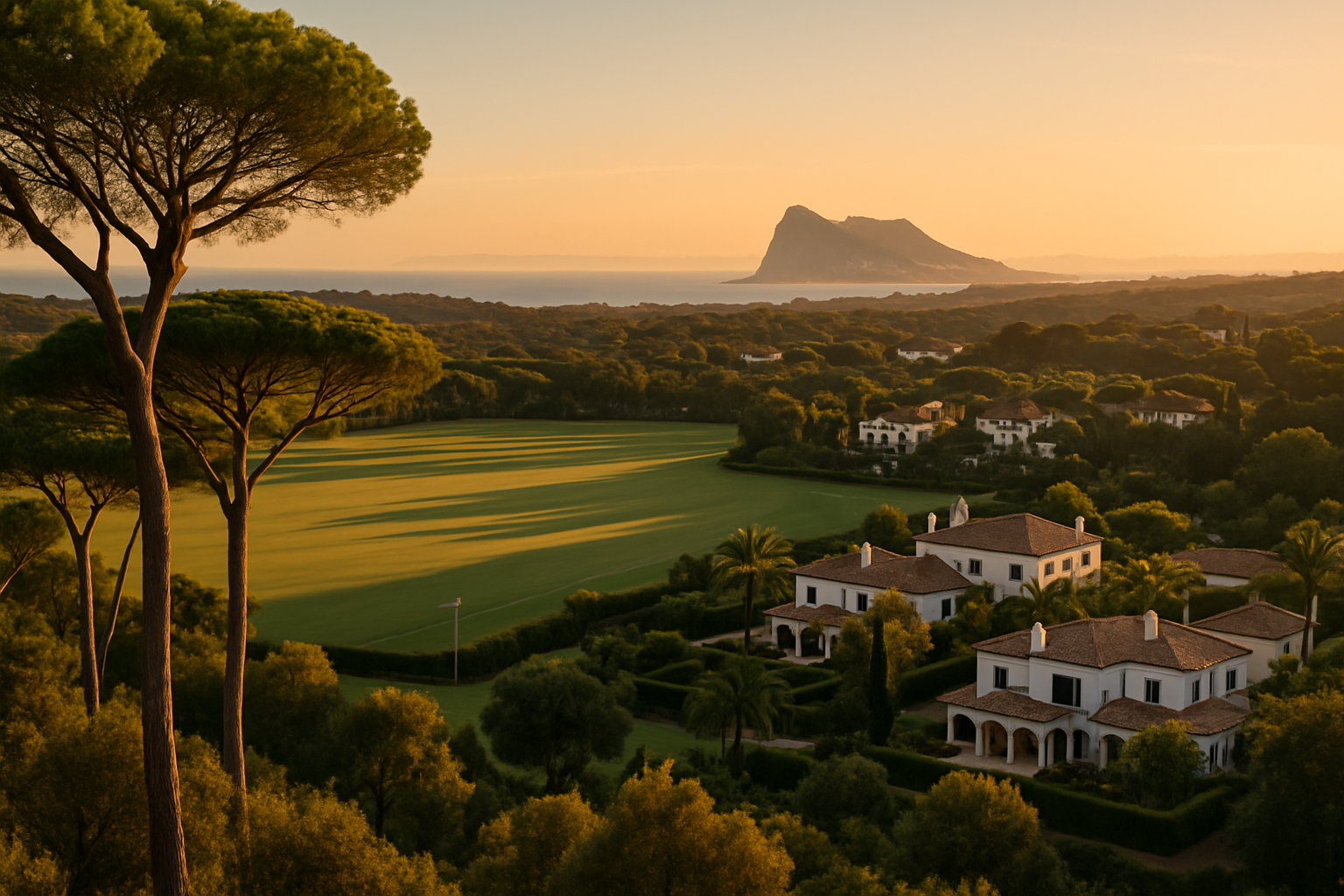
The Marbella Club opened in 1954 on what was then an unpaved coastal track running west from the old town. Alfonso de Hohenlohe had come to the Costa del Sol looking for something he could not precisely name; what he found, and what he built around the finding, was a template for how serious European money would choose to spend its summers for the next four decades. The hotel is still there, largely unchanged in silhouette, set back from the road behind its gardens. The axis it anchored — four kilometres of coastline between Marbella's centre and the marina at Puerto Banús — has become one of the most closely held residential corridors in southern Europe.
Approximately 800 residences occupy the strip. Around 100 of those are genuinely beachfront, meaning they sit between the N-340 coastal road and the sea. The rest are second-line: behind the road, on slightly elevated ground, with varying degrees of sea visibility depending on plot position and what has been built in front. The distinction matters more than agents typically let on.
What the Numbers Say, and What They Don't
One figure on this strip can be published honestly, and it is an asking figure: the median of what sellers are requesting, printed with its sample size and date on the Marbella Property Index (museselection.es/marbella-property-index). It is not what anyone paid. Spain publishes no per-property closing prices, so no source — this desk included — can honestly quote a transaction count, a turnover rate, or a year-on-year movement for these four kilometres. What the register does show is dispersion: the spread of asking metres across a single corridor is wide enough that the median describes no individual address on it.
What replaces the missing velocity data is observation, and it should be read as observation. The residences here are held by principals who are under no financial pressure to sell, and the buyers are conducting the kind of due diligence that takes months rather than weeks. Where price and condition are already matched to the current asking register, the conversation is short. Where they are not, the residence waits — sometimes for a specific buyer, sometimes for a specific neighbour. Some addresses on this strip have not changed hands since the 1970s. The Golden Mile does not trade frequently; it accumulates.
The Beachfront Tier
The roughly 100 beachfront properties form their own micro-market with limited connection to the second-line comparable. Supply here is structurally fixed: the coastal protection law means no new beachfront units will be created, and any demolition and rebuild must respect existing footprints in ways that constrain ambition. What changes is the quality of what sits within those footprints. A number of the original low-rise villas built in the 1960s and 1970s have been comprehensively rebuilt internally while maintaining approved external envelopes — a quiet renovation strategy that produces houses with period presence and contemporary infrastructure.
Pricing on direct beachfront addresses is less sensitive to the headline €/m² figures and more a function of plot width, garden depth, and the precise relationship to the beach path. Two properties on the same stretch of sand, priced within fifteen per cent of each other, can represent substantially different propositions once you understand the geometry.
The Puente Romano Section
The stretch immediately around the Puente Romano hotel is the axis's densest section, and its most studied. The hotel opened in the mid-1970s around an original Roman bridge — the bridge is genuine, the rest built around it — and its presence concentrated residential development on both sides. The villas and low-rise apartment complexes within a short radius of the Puente Romano are among the most consistently sought-after addresses on the strip, less because of the hotel itself and more because the area's configuration — the road, the river bed, the beach club access — produces a scale that feels managed rather than compressed.
Off-market activity here is significant, and nobody can put a percentage on it — unpublished instructions are, by definition, uncounted, so any off-market share figure is constructed rather than measured. What can be described is the mechanism. Owners of the better addresses do not routinely instruct open-market campaigns, and the properties that do appear on portals are, as a rule, either newly reconstructed or are testing a price that has not yet found its level. This is not a criticism — it is a structural condition that shapes how a search should be conducted.
The Second Line and Its Variation
Behind the coastal road, the second-line plots are more varied than the beachfront tier suggests. Elevation varies meaningfully across even short distances: a villa fifty metres back from the road at two or three metres of natural height gain can have unobstructed sea views over its neighbours, while one at the same distance on flat ground may look into a garden wall. The original 1960s and 1970s urbanisation plots were generous — often two thousand square metres or more — and those that remain intact are the ones most likely to attract buyers who want to build or extensively rebuild rather than inherit someone else's layout.
The slow attrition of Hohenlohe-era plots into modern rebuilds is one of the defining processes on the Golden Mile at present. Some of the original low-density villa configurations — single storey, shallow footprint, large garden — are being replaced by contemporary structures that use the full buildable envelope. This is neither good nor bad in itself; the quality of what replaces them varies enormously. What it does mean is that the character of certain streets is changing in ways that affect the value of adjacent properties, and that a plot-by-plot understanding of what exists and what has been approved nearby is a precondition of any serious purchase in the second line.
The [Golden Mile's layered structure and current inventory](/districts/golden-mile) reflect this heterogeneity: the addresses that have stayed in the same hands since the original urbanisation and those entering the market post-rebuild occupy different registers of the same corridor.
The Western End: Approach to Puerto Banús
As the axis approaches Puerto Banús, the residential density increases and the plot sizes compress. The marina itself is a different typology — apartment buildings, a commercial perimeter, a different buyer profile — but the final kilometre of the Golden Mile before the marina entrance still contains some of the larger private villa compounds. These tend to be walled, set back, and less visible from the road, which is partly why they do not surface in discussion as frequently as the Puente Romano section does.
Puerto Banús was built by José Banús and opened in 1970 — a real-estate project as much as a marina. Its proximity to the western end of the Golden Mile has shaped values in both directions: it provides a practical amenity anchor, and its commercial character creates a gradient that buyers from quieter European markets sometimes factor into their address preference. That gradient is well-understood by the market; it does not surprise buyers, but it does influence them.
A Strip That Holds Its Own Counsel
What the Golden Mile offers is not the privacy of an estate — La Zagaleta above Benahavís operates on a different logic entirely — nor the altitude and stillness of Sierra Blanca's slopes above the city. It offers proximity: to the sea, to the road, to the infrastructure of a functioning coastal town. Buyers who find what they are looking for here do not typically revise the decision — a pattern the desk reads in who stays, not in any published tenure figure. The ones who leave tend to be those who discovered, after the fact, that they wanted something the strip does not provide — more land, more elevation, more distance from the movement of the road.
The road itself — the old N-340 — is the axis's defining constraint and its defining character simultaneously. It runs the length of the strip, separating inland from beach. It carries noise. It also carries history, in the form of the route along which Hohenlohe, Banús, and the first generation of European buyers drew their line. Whether that history registers as context or as impediment is the first question worth settling before arriving here in earnest.