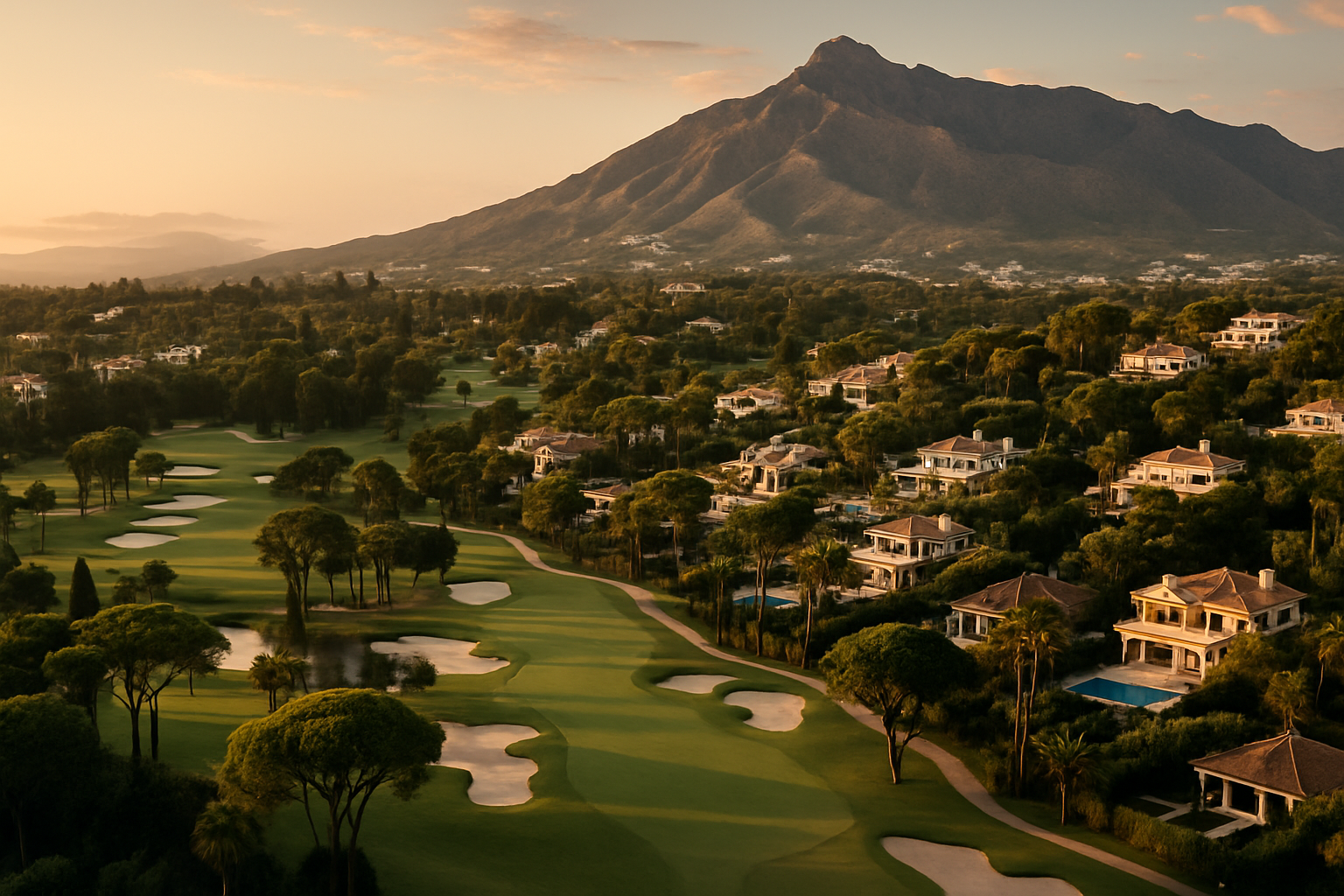
The gate at kilometre 38
There is one entrance. It sits at kilometre 38 of the A-7, the coastal highway that runs west from Marbella toward Gibraltar, and it opens onto a road that climbs through umbrella pines and scrub oak into the hills above Benahavís. The gate does not announce itself. There is no billboard, no fountain, no gesture toward the scale of what lies beyond it. If you have not been told where to look, you will pass it.
That quality — visible only to those already oriented — turns out to be a reasonable introduction to La Zagaleta itself.
What it is, in plain terms
La Zagaleta is a private residential estate covering nine square kilometres of the Serranía de Ronda foothills, approximately twelve kilometres inland from the Marbella coast. It was established in 1991 on land that had previously served as a private hunting reserve for Adnan Khashoggi, the Saudi arms dealer whose appetite for singular real estate left a particular mark on this stretch of Andalusia. The land changed hands, the hunting lodge gave way to a development plan, and the first residences were completed in the mid-1990s.
Today the estate holds about 230 plots. It operates two private golf courses — one of which is reserved exclusively for residents — a heliport, an equestrian centre, and the full infrastructure of a small self-contained settlement. Refuse collection, security, road maintenance, and utilities are handled internally. The ratio of staff to residents is, by most accounts, higher than in a good hotel.
Plot sizes begin at roughly 3,000 square metres. Many are considerably larger. The effect, across nine square kilometres with only about 230 plots, is one of deliberate spaciousness — a density closer to an agricultural estate than a residential development.
The architecture, honestly described
The building stock spans nearly three decades, and the range shows. The earliest residences, completed in the second half of the 1990s, are classical Andalusian in register: terracotta, arched colonnades, pitched clay-tile roofs, formal gardens arranged around central courtyards. They were built to a standard that reflected the ambitions of the original developer, and the best of them have aged well. Some have not.
From roughly 2010 onward the architectural brief shifted. Buyers arriving with contemporary tastes — and, increasingly, contemporary budgets — commissioned work that reads as contemporary European rather than regional Andalusian: glass volumes cantilevered over hillsides, interior-exterior plans centred on infinity pools and unobstructed views toward the Mediterranean. The most recent new-build completions, in 2023 and 2024, sit entirely within this register.
The result is an estate with no single architectural character. That is not a criticism. It reflects the genuine evolution of a place that has been lived in and renewed over thirty years, rather than assembled at a single moment for a catalogue. What the best properties share, regardless of period, is quality of construction and the underlying advantage of the land: elevation, privacy, and a southward orientation that keeps most plots in light for the better part of the day.
The market, and what can honestly be said about it
Asking prices are the only prices anyone can quote at La Zagaleta, and here even those are thin. The register prints the estate's median with its sample size and date on the Marbella Property Index (museselection.es/marbella-property-index), and the sample is small enough that one unusual instruction moves it — read it as a marker of the register the estate occupies, not as a measurement of it.
What cannot be quoted at all is the completed side. Spain publishes no register of sales at property level, so no source — this desk included — can put a defensible transaction count, turnover rate or off-market share on the estate. What can be described is the mechanism those missing numbers point at: the approval process for new residents means sellers frequently have a clear idea of who the appropriate next owner might be before any formal process begins. Introductions are made. Terms are discussed. The property does not need to find its buyer because the buyer, in many cases, is already known to the community.
For a buyer approaching from outside that network, this compression of the visible market is the central practical challenge. The [active Zagaleta catalogue](/districts/la-zagaleta) at any given moment represents a fraction of what is actually in play. The remainder circulates through advisory relationships, and accessing it requires being inside those relationships before the search formally begins.
Membership by approval
La Zagaleta does not operate a conventional homeowners' association. Prospective buyers are subject to a vetting process conducted by the estate's management, and residency — in the full sense of community membership — requires approval that goes beyond the legal completion of a purchase.
This is not unusual in the context of comparable European estates, but it is worth stating plainly because it changes the nature of the acquisition process. The relevant question is not only whether a buyer can afford a property, but whether the estate's existing membership considers them a suitable addition to a community of this size. The criteria are not published. In practice they concern reputation, conduct, and the judgment of existing members who may be consulted informally.
The practical implication is that the advisory relationship matters more here than in most other contexts. A buyer arriving without an introduction, attempting to transact directly through a portal listing, will encounter a process that is not designed for them. This is not obstruction — it is the structure of a private estate operating as its founders intended. [Understanding how that process works in practice](/guides/la-zagaleta-membership-explained) before beginning a property search is time well spent.
What the estate has become
Founded as a development, La Zagaleta has matured into something that development language does not quite fit. A parish is perhaps closer — a settled community with its own rhythms, its own internal social life, and a relationship to the surrounding landscape that residents tend to describe in terms of attachment rather than investment.
People who buy here tend to stay. That is a desk observation rather than a statistic — nothing in Spain records how long a residence is held, and on an estate this small a single sale would distort any figure that did exist. What is visible instead is generational: the owners who arrived in the 1990s and early 2000s are beginning to move on, and a proportion of long-held residences is changing hands quietly as they do.
The buyers taking those properties are, broadly, younger. They arrive with different expectations about interior specification and smart-home infrastructure, and they frequently renovate substantially before occupation. This is the mechanism by which the estate renews itself without the disruption of large-scale new development. The land parcel is finite. There are no further phases to sell.
What it is not
La Zagaleta is not a resort. The golf courses are private, and they are not amenities offered to non-residents as a commercial service. The heliport is operational, not decorative. There is no hotel on the estate, no spa open to day visitors, no beach club running shuttles from the gate.
It is also not a gated community in the suburban sense — the version of that concept that implies proximity and shared walls and a management committee adjudicating parking disputes. The plots are large enough and the residences sufficiently separated that it is entirely possible to live at La Zagaleta for an extended period without forming a clear picture of who your nearest neighbours are. That isolation is, for most buyers who end up here, the point.
The comparison that recurs in conversation, when residents are asked to characterise the estate, is not to other Marbella addresses. It tends toward comparable private estates in Tuscany, or the Luberon, or a handful of gated communities in the Swiss cantons — places where the value proposition is fundamentally about what is excluded rather than what is included.
A final observation
There is a version of this article that would end with a summary of the investment case — capital appreciation, the structural scarcity of a fixed land parcel. The scarcity is real and checkable: nine square kilometres, about 230 plots, no further phases to sell. The appreciation is not quotable, and this desk will not invent it — no one can put an honest year-on-year figure on an estate whose sales are never published.
But the buyers who are well-suited to La Zagaleta are typically not running that calculation as their primary one. They are looking for a specific quality of life that combines genuine privacy with the infrastructure of a well-run private estate, within reasonable reach of an international airport and a coast with a functioning social and commercial life. They have usually looked at several other addresses — on the Golden Mile, in Sierra Blanca, sometimes further afield — and found them either too exposed or too thin in their amenities.
La Zagaleta answers both objections. Whether it answers them for a particular buyer depends on whether that buyer values what the estate has chosen to be: settled, quiet, unhurried, and entirely indifferent to the approval of the market below.