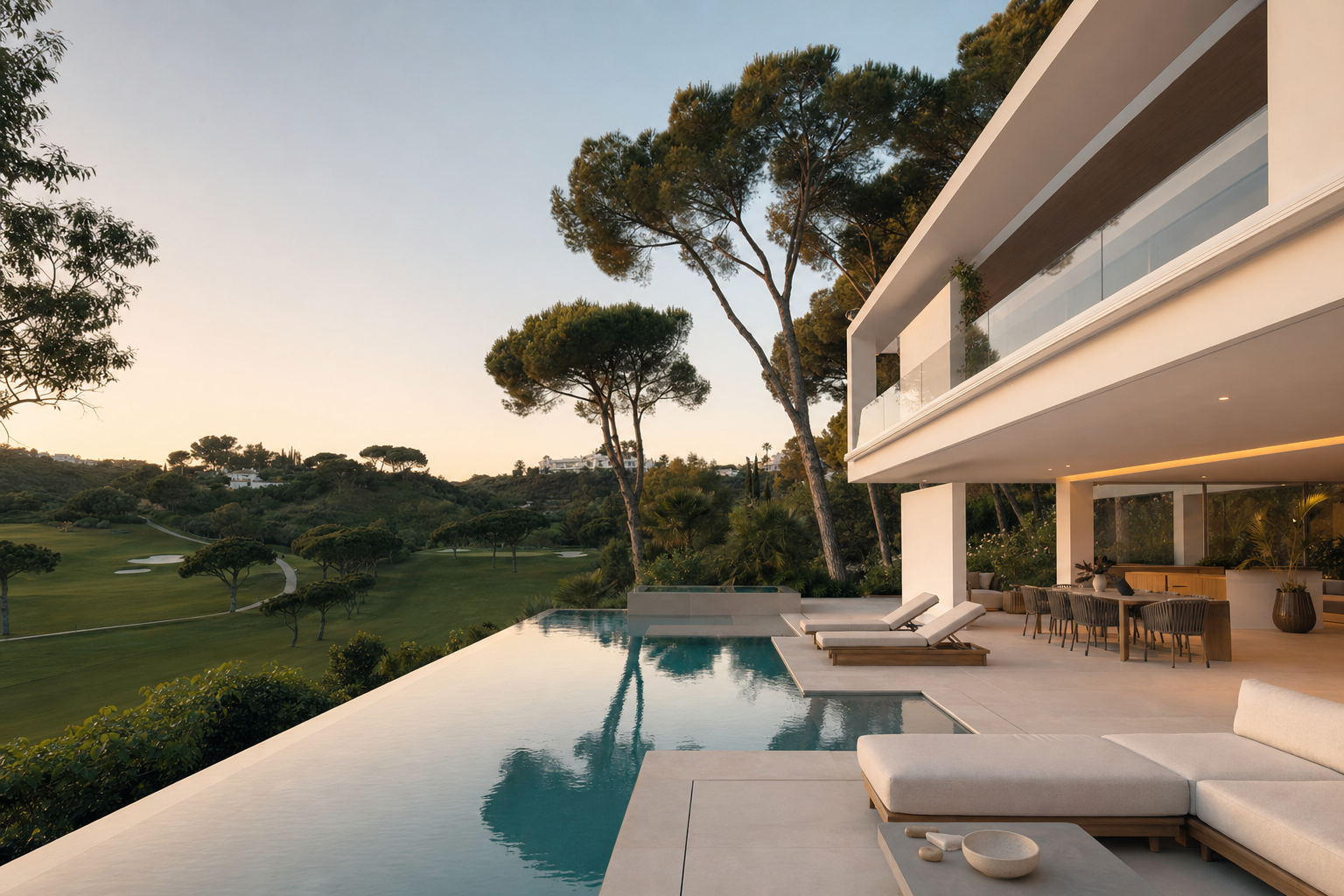
The Address and What It Actually Means
Cascada de Camoján occupies the lower slopes of the Sierra Blanca massif, roughly 300 to 500 metres above sea level and perhaps ten minutes by car from Marbella's old town. It is not a gated community in the conventional sense — there is a security perimeter and controlled access, but the urbanisation is large enough, and its roads varied enough, that it functions more like a small hillside neighbourhood than a single managed estate. The name refers to the seasonal waterfall — *cascada* — that descends through the ravine bisecting the zone, and the topography that watercourse created is partly responsible for the irregular plot geometry that makes construction here technically demanding and architecturally interesting.
The orientation is predominantly south and south-west. From the upper plots, on a clear morning, the view takes in the full coastal arc from Gibraltar to the hills behind Fuengirola, with the Alboran Sea running flat to the horizon. This is not a view that requires a drone photograph to communicate — it is simply the reason the land was always going to attract serious building budgets.
Within the register we maintain at Muse Selection, Cascada de Camoján sits alongside Sierra Blanca, the Marbella Golden Mile and La Zagaleta as one of the zones at the top of the register. The distinction between Cascada de Camoján and the adjacent Sierra Blanca urbanisation below it is meaningful: Sierra Blanca carries more established names and more compound-style properties, while Camoján tends toward newer construction on steeper terrain, with correspondingly more architectural ambition in the façades.
The Modern Build Cycle: Roughly 2015 to Present
The contemporary stock in Cascada de Camoján is largely a product of a specific decade. The zone existed before this — there are villas from the 1990s and early 2000s here, typically in an Andalusian-Mediterranean idiom with terracotta roofs, arcaded terraces and informal garden layouts. Those properties have not disappeared, but they now represent a minority of what is offered.
The shift toward the current architectural character began around the middle of the last decade, and the build cycle that followed, running from approximately 2015 through to the present, produced the majority of what most people now picture when they search for a modern mansion in Cascada de Camoján.
The typology is consistent: flat or low-pitch roofs, extensive use of large-format concrete or stone cladding, full-height glazing on the south elevation, infinity or overflow pools positioned to hold the sky in the water surface, and interior volumes arranged to prioritise the view corridor from kitchen through living room to terrace. Basement levels are common — the slope of the terrain makes excavation almost inevitable, and the space is typically used for garaging, staff quarters, cinema rooms or wellness facilities. Plot sizes range from around 1,200 square metres on the tighter parcels near the perimeter road to 3,000 square metres or more on the broader hillside plots in the upper sections.
Build quality within this cycle is uneven. Some projects were developed by experienced promoters using German or Scandinavian engineering oversight and sourcing finishes from Italian suppliers. Others were speculative builds that cut costs where costs could be cut without being visible at the point of sale. The difference becomes apparent during a thorough inspection and matters considerably when calculating renovation or maintenance budgets.
Asking Prices: What Moves Them
No price band is printed here. Spain publishes no per-property closing prices, and the register publishes its asking median for a zone as a whole, with its sample size and date, not for a typology inside it. Current asking prices by zone, each with its sample size and date, are on the Marbella Property Index (museselection.es/marbella-property-index).
What moves an asking price inside the zone is legible without a number: plot position and elevation, the size of the built area, of the pool and of the garden, the year and quality of the build, and whether the view is unobstructed. A residence completed in the last few years with the full suite of contemporary amenities asks more than an unreformed villa of the same footprint. The gap between asking and closing prices cannot be published: Spain records no per-property closing prices.
At the top of the zone the market is thin: there are only so many plots capable of supporting a house of this quality, and they do not come back to market frequently. Pricing at that level reflects plot position, build specification and the scarcity of the address rather than a body of comparable sales, because none is published.
What the Buyer Profile Looks Like
The pattern we observe across the instructions in this zone is that Cascada de Camoján attracts buyers who have already resolved the question of whether Marbella is the right location. They are not comparing it to Ibiza, Saint-Tropez or Comporta in an open way — the comparison has been made, and Marbella won, largely on the grounds of year-round liveability, infrastructure, schooling for families with children, and the relatively uncomplicated tax treatment for residents establishing fiscal domicile in Spain.
Within Marbella, the choice of Camoján over the Golden Mile or a beachside position in Los Monteros or Guadalmina tends to reflect a preference for altitude, privacy and the particular quality of light and air that comes with being above the coastal haze. It is a different proposition to a beach house — the sea is present as a view, not as an immediate physical environment. Buyers who want the sea itself tend to look elsewhere.
On nationality the desk can offer an observation from its own enquiries, not a count: no public dataset records buyer nationality at this price level. Scandinavian, German and Belgian families are present in the zone, and buyers from the Gulf states ask about it for its altitude, its security infrastructure and the short transfer from Málaga airport.
Practical Considerations Before Buying
The terrain creates a few practical realities that are worth stating plainly. Access roads within the upper sections of the urbanisation are steep, and some of the internal *calles* are narrow enough that larger vehicles — including delivery lorries and construction equipment — require careful manoeuvring. This is not an obstacle to daily life, but it is a factor in renovation logistics and should be considered when planning any significant works.
Water pressure at higher elevations can vary, and several properties have installed private pressure systems as a result. The position above the valley floor means that while summers are fractionally cooler than on the coast, the microclimate is still warm and dry from May through October. Winters at this altitude occasionally bring morning mist and, rarely, a few days of cold that the coast below does not experience to the same degree.
The urbanisation has its own community administration and security costs. Community fees are set by each community's approved budget; no public source gives a range. Ask for the receipts of the last twelve months.
For buyers considering construction rather than a completed property, the planning framework is the *Plan General de Ordenación Urbana* of Marbella municipality, amended most recently in terms of height and occupation restrictions in 2019. The allowable occupation of residential plots is generally 25 to 30 percent, with height limits of two storeys above ground, though the interpretation of basement levels in relation to these limits requires specific legal and technical advice for each parcel.
A Note on the Market Moment
No appreciation or year-on-year figure exists for these addresses: it would need closing prices at two dates, and Spain publishes none. Any figure offered for the movement — ours included — would be a guess with a decimal point.
What the desk can report is its own enquiries: interest per available property is strong, which is a different thing from transaction volume. Properties that come to market here tend to do so for lifestyle reasons rather than financial distress, which changes the negotiation dynamic considerably.
The zone is quiet in the way that places are quiet when the people in them have chosen privacy deliberately. The road that runs through the upper section carries little traffic in the mornings; the sound that reaches the terraces is wind in the pine trees and, occasionally, the waterfall that gives the address its name. Whether that constitutes value at these price points is, ultimately, a question each buyer answers for themselves.