What Sierra Blanca Actually Contains
Sierra Blanca sits on the lower slopes of La Concha mountain, directly above the Marbella Golden Mile. The enclave is gated, with 24-hour perimeter security and a road structure that keeps through-traffic out almost entirely. Elevation ranges from roughly 80 metres at the lower entrance to around 280 metres at the upper residential boundary, which means altitude — and therefore the quality of the sea view — varies considerably from plot to plot.
The building stock is not homogeneous. The estate was developed in phases beginning in the late 1980s, and significant construction continued through the 1990s and early 2000s. That history left a substantial layer of traditional Mediterranean architecture: wide arched loggias, terracotta roof tiles, ochre render, internal courtyards organised around fountains. These villas remain well maintained and still find buyers, but they represent a different product category from what has been built or comprehensively renovated since roughly 2016.
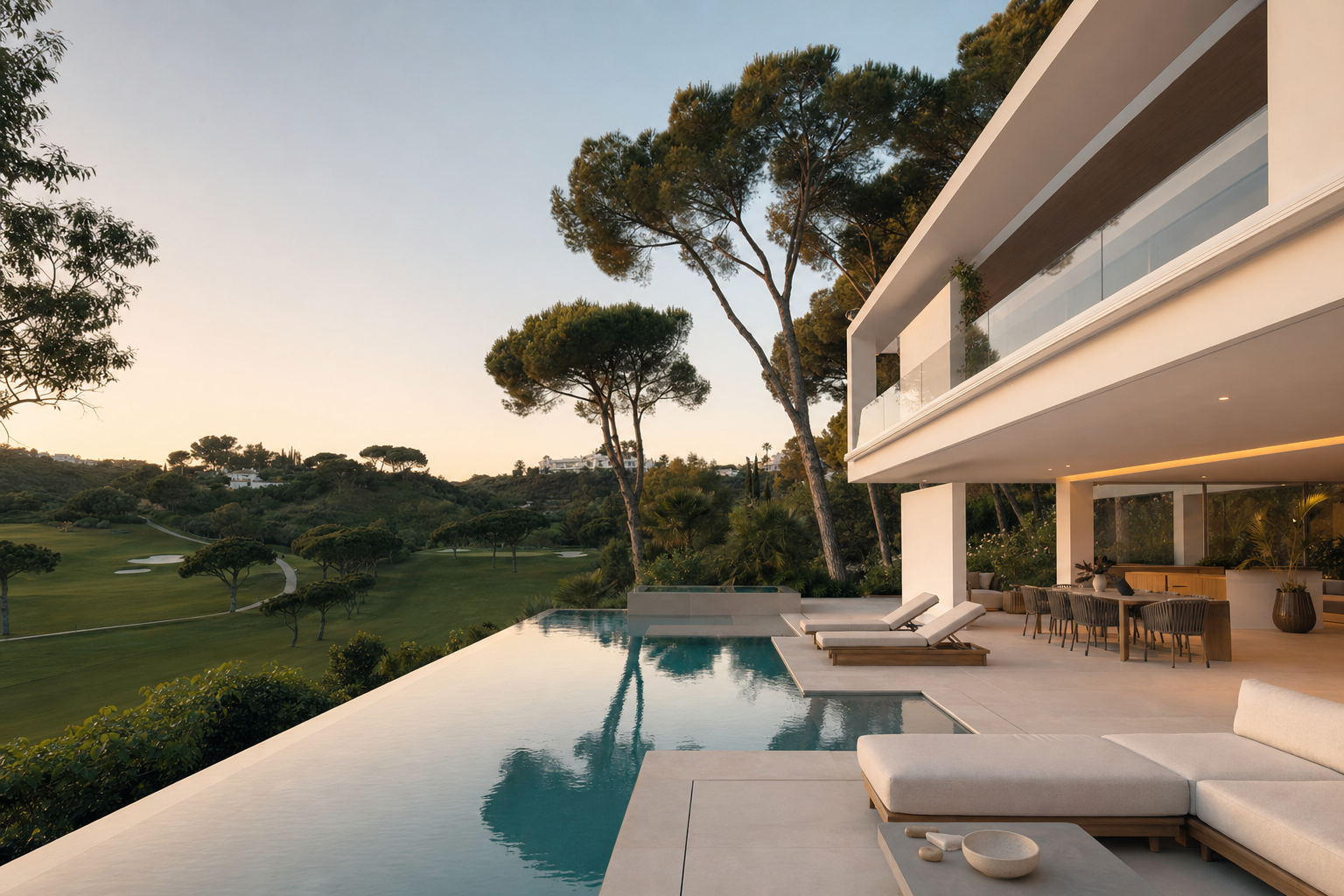
The modern layer within Sierra Blanca is smaller than the traditional one, and that is worth stating plainly. Buyers who arrive with a specific image — clean geometry, flat rooflines, floor-to-ceiling glazing oriented toward the sea, integrated indoor-outdoor living — are looking at a subset of the estate, not its full inventory. Within Sierra Blanca, only part of the available stock meets a strict modern-architecture definition, and sea view is a further filter that reduces the count again.
How We Define and Track Sea Views
The phrase "sea view" is applied liberally across Marbella real estate marketing, and Sierra Blanca is no exception. Our view-classification methodology tries to be more precise. We distinguish between four categories: full panoramic sea view, where the Mediterranean is the dominant visual element from principal living spaces and main terrace; partial sea view, where water is visible but framed or interrupted by vegetation or neighbouring structures; glimpse view, where the sea appears only from upper-floor terraces or specific corners; and no sea view, where orientation or topography makes water visibility impossible regardless of conditions.
For a modern villa in Sierra Blanca to qualify for the first category of our sea-view classification, we require the view to be confirmed from the main reception room and at least one primary terrace at ground-floor or pool-deck level — not solely from a rooftop solarium. This matters because a significant number of listings advertise sea views that are real but accessible only from a roof terrace reached by internal stairs, a feature that becomes less relevant when considering how daily life in the property actually works.
Elevation is the primary variable. Villas positioned on the upper roads of Sierra Blanca — the streets that climb toward the Cascada de Camoján boundary — tend to sit high enough that La Concha's foothills do not obstruct the southern sightline. Villas on the lower perimeter, closer to the N-340, sometimes face toward garden and neighbouring properties rather than sea. GPS coordinates and plot elevation data from the catastro, cross-referenced against satellite imagery and our own site visits, form the basis of the register classification. We update classifications when we have a reason to revisit — a renovation that raised a terrace level, a mature tree line that has grown to interrupt a previously clear view, a neighbouring structure completed since the last visit.
The Modern Inventory: What Exists
A genuinely modern villa in Sierra Blanca — built from new or gutted to structural frame and rebuilt — with a confirmed full panoramic sea view represents a narrow category. Spain publishes no per-property closing prices, so no sold price, sales count or volume can be stated for any zone. Current asking prices by zone, each with its sample size and date, are on the Marbella Property Index (museselection.es/marbella-property-index).
What separates one asking price from another is a set of variables that move somewhat independently: plot size and buildability, internal square metres, pool and garden configuration, finish level, and the degree to which the architecture genuinely prioritises the view rather than treating it as an incidental feature. A 600 square metre modern villa on a 1,500 square metre plot at middle elevation, well finished but using standard high-specification materials, asks a different price than an 800 square metre property on a 2,200 square metre elevated plot where the architect has designed the entire living sequence around the sea orientation.
Partial sea-view modern villas, and those where the view classification is less certain, ask less. No public dataset measures the size of the premium: it would need matched closing prices, and Spain publishes none. Sierra Blanca benefits from its distance to Marbella centre, which is under ten minutes by car, and from its adjacency to the Golden Mile, which means residents have access to both the beach and the mountain without committing to one exclusively.
Modern vs Traditional: How Buyers Are Choosing
The preference pattern we observe is not a clean shift toward modern. It is more segmented than that. Buyers arriving from northern European markets — particularly Scandinavia, Germany, and the Netherlands — show a strong and fairly consistent preference for contemporary architecture. They tend to prioritise the thermal performance of modern construction, the maintenance logic of minimal surfaces, and an aesthetic that aligns with residential expectations at home. For this group, the traditional Sierra Blanca villa, however spacious or well-located, requires a mental adjustment that some make and others do not.
Buyers from Middle Eastern markets, and a portion of Latin American buyers, show more mixed preferences in the desk's enquiries. Traditional architecture with high-quality interiors — marble, coffered ceilings, formal reception rooms — retains genuine appeal for buyers who have considered and set aside modern alternatives.
Domestic Spanish buyers, when they enquire here, tend toward the upper-traditional category — large plots, established gardens, architectural weight.
The consequence of this segmentation is that both categories continue to find buyers. The modern villa with a sea view asks a premium, and the traditional villa on a comparable plot has its own audience. They are serving different buyer profiles.
Off-Market Stock and the Introduction Layer
A portion of the market's most interesting modern inventory does not appear in any public portal. Some residences are not published and are shown by introduction. These are properties whose owners have chosen not to list publicly, for reasons ranging from privacy to pricing discretion to a simple preference for qualified contact rather than broad exposure.
In that layer, some properties are held by owners who would transact at the right number but are not actively seeking a sale. Others are properties where a previous public listing was withdrawn and the owner is now selectively open to direct approaches. The price expectations are sometimes higher than for comparable listed properties — reflecting the premium that some owners place on privacy — and sometimes lower, where an owner prefers a quiet transaction to an extended marketing period.
Seeing these residences requires an introduction rather than a portal search, which is a structural feature of how the upper end of the Marbella market operates rather than an artificial restriction. They are kept apart from the published register precisely because the terms of access matter to their owners.
Reading the Zone in 2026
Sierra Blanca is not evolving rapidly in terms of new construction. Plot availability within the enclave is limited, and the planning constraints on La Concha's slopes restrict density. What is changing is the renovation layer: properties built in the 1990s and early 2000s are reaching an age at which substantial refurbishment becomes logical, and a number of buyers have acquired traditional villas with the explicit intention of full architectural conversion — retaining only the structure or the plot and rebuilding to a modern programme.
This renovation pipeline is gradual and does not represent a transformation of the estate's character. Sierra Blanca retains its established, somewhat formal quality. The security infrastructure, the road maintenance, the average age of the resident population — these factors all contribute to an atmosphere that is quieter and more settled than, say, the upper roads of Nueva Andalucía or parts of Benahavís where development activity is more visible.
For someone specifically seeking a modern villa in Sierra Blanca with a confirmed sea view, the honest summary is that the category exists, is genuinely valuable, and is genuinely constrained. Few properties at any given moment meet both criteria without qualification, and the planning and topographic limits on new construction keep it that way. The buyers who find the right property here tend to have approached the search with patience and a willingness to ask about residences that are not published.