What a compound actually is
The word gets used loosely. In estate agency copy it sometimes describes nothing more than a large villa with a staff annex attached to the garage. What a genuine multi-generation family compound on the Costa del Sol represents is something more considered: two legally distinct or functionally independent dwellings on a single cadastral plot, planned so that two households can live in proximity without either surrendering the sense of having their own home.
The configurations vary. The most common is a principal villa of four to seven bedrooms with a separate guesthouse of two or three bedrooms, each with its own kitchen, its own entrance from the shared garden, and — in the better examples — its own terrace orientation so the two structures do not look directly into one another. A second configuration places two villas of roughly equal scale side by side on a larger plot, sometimes with a shared pool as the mediating element, sometimes with a second pool so that neither household inherits the social obligations of the other. A third, less frequent arrangement is a cortijo-style property where outbuildings have been converted to habitable standard over time, producing a cluster of structures around a central courtyard.
Families buying these properties tend to be in a specific moment: grandparents who want proximity to grandchildren without daily cohabitation, adult siblings splitting an acquisition, parents funding a purchase that accommodates an adult child's family on the same grounds. The financial logic and the emotional logic are different in each case, but the spatial requirement is the same.
Where the inventory sits
On the western Costa del Sol, compound-configuration properties are concentrated in a handful of zones where plot sizes permit it. La Zagaleta, the private residential community in the hills above Benahavís, has some of the largest private plots available anywhere on the coast — several exceed five thousand square metres — and a number of owners have used the space to build secondary structures over the years, sometimes with planning permission obtained at the time of original construction, sometimes through subsequent applications. The community's controlled access makes it particularly suited to multigenerational use: the security perimeter is shared, which reduces one layer of concern for older family members living in the guesthouse.
El Madroñal, adjacent to La Zagaleta, operates on similar principles — gated, elevated, quieter — and suits precisely this kind of family arrangement. Cascada de Camoján on the slopes above Marbella's Golden Mile offers smaller plots but more urban access, and the existing villa stock there sometimes includes a pool house or studio that has been upgraded to residential use.
In the Benahavís municipality more broadly, planning conditions have historically been more permissive regarding ancillary structures than in the coastal strip itself, which is one reason why a disproportionate share of genuine two-villa plots sits in that inland corridor rather than in Marbella proper. Nueva Andalucía, with its established villa urbanisations around the golf valley, also produces compound-suitable stock, though plots there are generally smaller and the secondary structure is more often a converted outbuilding than an architecturally considered guesthouse.
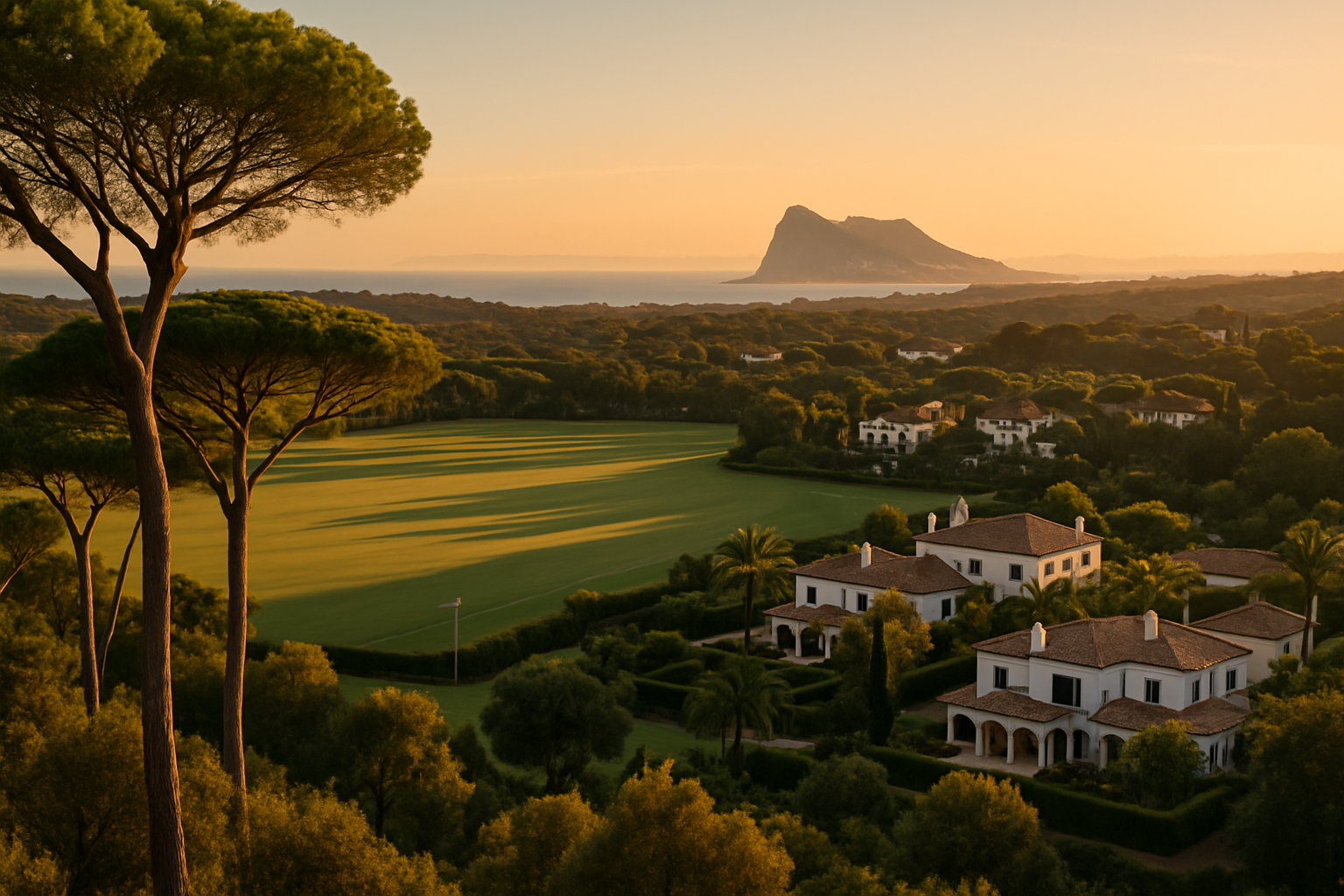
Sotogrande, at the western end of the Costa del Sol in Cádiz province, deserves a separate note. The polo estate architecture there — low-slung, horizontal, set in generous grounds — lends itself naturally to compound arrangements, and several of the older cortijo-influenced properties in the interior of the estate have secondary buildings that predate the current ownership. For families who want the compound experience at a slightly different pace of life from Marbella, Sotogrande is worth considering on its own terms.
The planning and legal questions
Buying a property with a secondary structure on the same plot requires clarity on several points that are sometimes glossed over in the initial presentation of a property. The guesthouse or second villa needs to have its own building licence, its water and electricity connections need to be legal and metered (or at minimum legally combinable), and if the intention is for the second household to have any independent legal status — for lending purposes, for inheritance planning, for eventual separate sale — the question of whether the plot can be divided horizontally needs to be addressed before purchase.
In Andalusia, the concept of the vivienda independiente within a single plot is recognised, but the conditions under which a secondary structure qualifies vary by municipality. Benahavís applies different criteria from Marbella, and Sotogrande sits in San Roque municipality with its own planning framework. A buyer acquiring a property specifically for multigenerational use should commission a technical architect's report on the secondary structure before exchange, not after. The questions are not insurmountable — most of the properties in this category that reach serious negotiation have resolvable situations — but they need to be documented.
Inheritance planning is a related consideration. Spanish succession law applies to Spanish-sited assets regardless of the nationality or residence of the owner, and Andalusia has its own regional rules that affect how property passes between generations. For families buying a compound with the explicit intention of its remaining within the family across two or more generations, a conversation with a Spanish tax and succession lawyer at acquisition stage, rather than when the question becomes urgent, tends to produce better outcomes.
What current stock looks like
In the working register at Muse Selection — compiled from shared listing feeds and deduplicated so that each residence appears once — compound-configuration properties represent a small fraction of total inventory: few listings at any given time genuinely meet the criteria of two independent living units on one plot, as opposed to a large villa with a small annex.
No price band is printed here for compounds: no feed flags a listing as a two-dwelling plot, so no median can be computed for the category, and Spain publishes no per-property closing prices. In the prime zones — La Zagaleta, the Golden Mile, Sierra Blanca — a compound is priced as the large plot it stands on; in parts of Nueva Andalucía away from the golf courses, on the lower slopes of El Madroñal and in the Benahavís countryside outside gated communities, the secondary structure may require investment before it functions as intended. Current asking prices by zone, each with its sample size and date, are on the Marbella Property Index (museselection.es/marbella-property-index).
There is a category of property that sits between these price points and appears with some regularity: an established main villa of five or six bedrooms, built in the 1990s or early 2000s, with a pool house that a previous owner converted to guest accommodation. These properties are often priced on the main villa's merits and the guesthouse is presented as a bonus. For a buyer with compound intentions, they can represent reasonable value if the secondary structure is properly legalised and the specification is adequate — but that due diligence step is essential.
Off-plan compound configurations do exist but are genuinely rare. Most developers building in prime zones design for a single-household buyer and have not adapted their typologies for multigenerational use. The exceptions tend to be smaller developers or individual architect-client projects where the client's brief explicitly specified two structures from the outset.
How families are using these properties
The use patterns that emerge over time are worth noting because they sometimes differ from the original intention. A family that purchases a compound imagining grandparents in the guesthouse and adult children in the main villa sometimes finds, within a few years, that the generation in the guesthouse prefers it — the smaller scale, the lower maintenance overhead, the sense of having a complete and self-contained home rather than a portion of a larger one. The original occupancy assumption reverses.
Some families use the compound configuration seasonally rather than year-round. The main villa is the summer base for the extended family, with both structures fully occupied for two months; the guesthouse serves as a rental or sits closed for the rest of the year. This model works financially but introduces management complexity — the guesthouse, if rented, needs its own tourist rental licence under Andalusian regulations, which adds another layer of compliance to the original purchase.
A smaller number of buyers are acquiring compound properties as a straightforward investment in family continuity — a place that exists outside the rhythms of any individual household, available to different branches of the family at different times, held in a family structure or foundation precisely because the intention is that it not be subject to individual inheritance decisions. This is a more sophisticated use of the compound model and requires more sophisticated structuring, but it is not uncommon among families with the means to approach property at that level of deliberateness.
A note on what is not easily found
Two things are consistently harder to find than buyers expect. The first is a compound where both structures are of genuinely equal quality — most two-building plots have a clear primary and a secondary, and the secondary was built to a different standard, at a different time, or with different materials. Parity of specification between two villas on the same plot is unusual and tends to command a premium when it exists.
The second is compound inventory in the coastal strip itself — on or near the beach, within walking distance of Puerto Banús or the Marbella centre. Plot sizes in those locations rarely permit it, and planning restrictions on the coastal zone limit ancillary construction. The compound model is almost entirely an inland or elevated product on the Costa del Sol. Families who want compound living and beachfront access tend to solve the problem not with a single compound purchase but with two separate acquisitions near one another, which is a different kind of arrangement and a different kind of commitment.
The properties that do work as multi-generation family compounds on the Costa del Sol tend to have been built by people with the same intention. The thought that went into the original design — the orientation of the guesthouse terrace, the placement of the shared garden relative to both entrances, the sound separation between the two buildings — is usually visible in the finished product. That quality of consideration is what separates a genuine compound from a large villa with a room above the garage, and it is what makes the search for one take longer than most buyers anticipate.