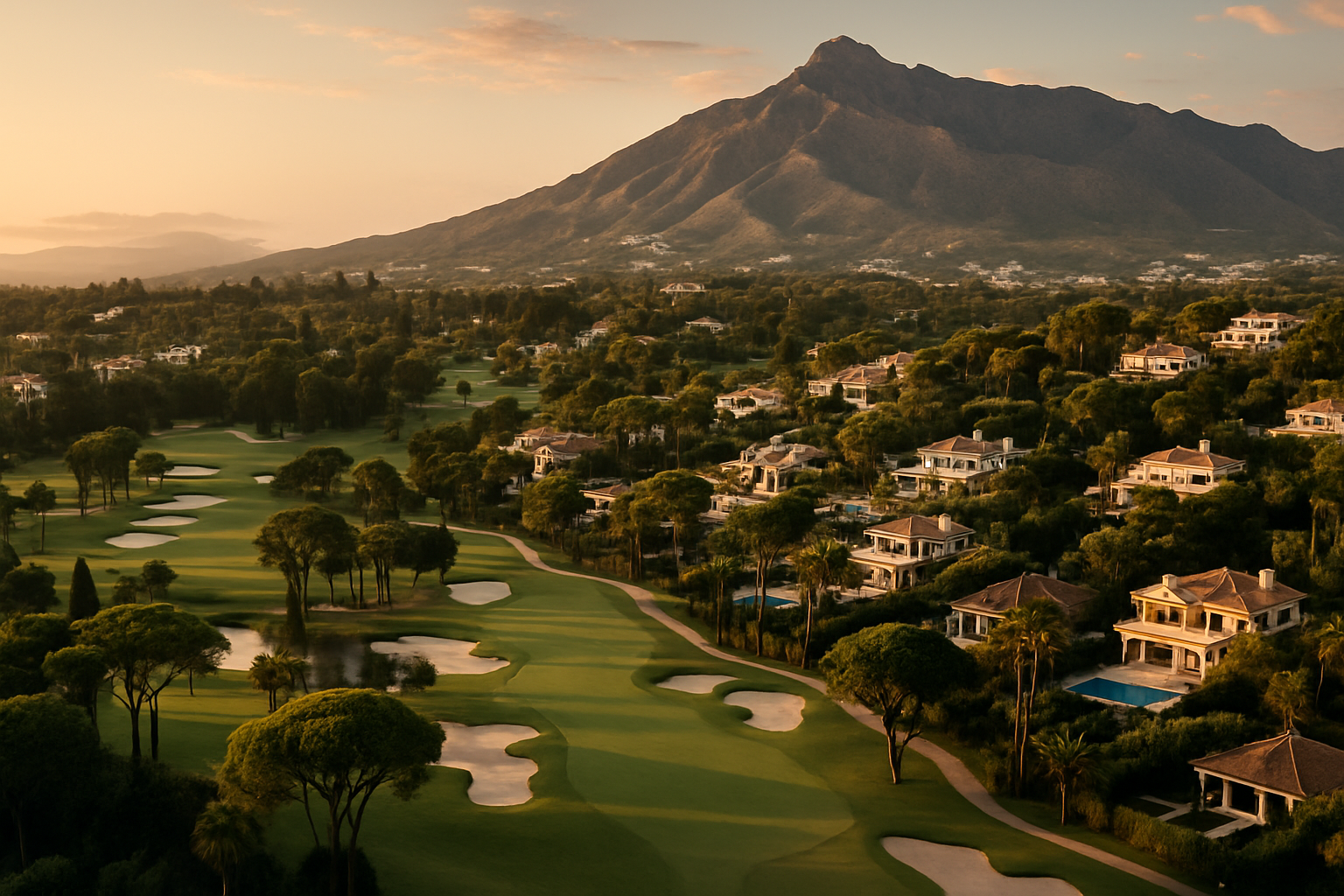
The lay of the land
Drive north from Puerto Banús for three minutes and the coast falls away behind you. The road climbs gently into a wide, bowl-shaped valley ringed by the lower foothills of the Sierra de las Nieves. The air is quieter here. The light is different — less reflective, more inland. This is Nueva Andalucía, and its organising logic is golf.
Four courses define the district's geography: Aloha, Los Naranjos, Las Brisas, and La Quinta to the northwest. They were laid out from the late 1960s onwards, and the residential fabric grew around them in overlapping rings — first the larger private villas on the fairway plots, then the urbanisations of the 1980s and 1990s filling the spaces between. The result is a district of considerable internal variety: a four-bedroom contemporary villa on a Las Brisas frontline plot and a two-bedroom apartment in an older Los Naranjos urbanisation are both, technically, Nueva Andalucía. The price gap between them is substantial.
What the market actually looks like
The prime tier — meaning the Aloha, Las Brisas, and Los Naranjos cluster, where plot sizes are generous and the fairway orientation is direct — sits at the top of the zone's asking range. Current asking prices by zone, each with its sample size and date, are on the Marbella Property Index (museselection.es/marbella-property-index).
The district figure as a whole is lower, pulled down by the long tail of older urbanisations where construction dates from the 1990s and the specification has not been updated. This is not a weakness, exactly. It is simply what happens when a district has been inhabited for decades rather than assembled in a single development phase. The compression between old stock and new-build replacement is, in itself, a structural feature of the market here. Buyers who understand that dynamic tend to navigate it well; buyers who do not tend to compare headline figures and draw the wrong conclusions.
The entry tier is where most of the enquiry concentrates, and no velocity figure can be attached to it — Spain records no completions at property level. What the register does show is depth of supply at the €1.5M–€2.5M level, and the buyers asking about it are typically upgrading from an apartment, or relocating a family from northern Europe and looking for a school catchment as much as a property.
The schools question
Few zones in Marbella carry the same concentration of family infrastructure as Nueva Andalucía. Aloha College sits within the district boundary. Swans International is close enough to be effectively local. For families with children of school age, this matters more than any individual room specification, and it shapes the buyer profile in ways that are legible on any weekday morning, if not in any dataset.
This is, broadly, a family-led market rather than a trophy market. The buyer is not primarily motivated by the statement value of the address. They are motivated by the quality of the daily life the address makes possible — golf within walking distance, schools within five minutes, the beach at Puerto Banús within ten. That profile tends to produce longer hold periods and lower speculative churn than you see in more conspicuous parts of the coast.
The replacement cycle
Much of the 1990s villa stock in the prime fairway positions is now being systematically replaced. The underlying logic is straightforward: the plots are large, the orientation is established, and the infrastructure — drainage, road access, utilities — is already in place. A developer or self-builder acquires a dated villa, demolishes it, and constructs something contemporary on a plot that would not be available in any newly planned urbanisation at any price.
The construction timelines are typically three to four years from acquisition to completion, and the finished product asks at the upper end of the published range for the zone or beyond, depending on specification — the current median asking rate, with its sample size and snapshot date, is on the zone index page. In our experience, the strongest demand for this new-build replacement stock comes from buyers who want the convenience and proximity of Nueva Andalucía but require a contemporary envelope — open-plan living, passive climate systems, larger glazed elevations — that the original 1990s builds cannot deliver without comprehensive renovation.
It is worth noting that comprehensive renovation of an older villa can approach the cost of new-build replacement, particularly once structural work is accounted for. This is not universally true, but it is common enough to inform the calculus at the point of acquisition. Buyers considering a project property in this valley are well served by working through those numbers before they commit.
The golf infrastructure as a fixed asset
The four courses are not decorative. They are the reason the district exists in its current form, and they function as a kind of permanent open space that no planning decision is likely to disturb. Frontline fairway plots carry a premium not merely for the view — though that is part of it — but for the certainty of outlook. In a densely developed coastal market, that certainty is itself a form of value.
Aloha Golf Club and Real Club de Golf Las Brisas both carry long institutional histories on the Costa del Sol. Los Naranjos is a more recent member-led operation but well-regarded regionally. La Quinta, partially overlapping with the Benahavís boundary, is quieter and more residential in character. The four together give the valley a supply of mature green space that is unusual for a district this close to a major commercial marina. Puerto Banús is three minutes south; the courses make it feel further.
What sits adjacent
Nueva Andalucía's edges are porous in useful ways. To the south, Puerto Banús provides the retail, restaurant, and marina infrastructure. To the north and west, the road towards Benahavís opens into smaller, quieter residential zones — El Madroñal, La Zagaleta — for buyers who find even Nueva Andalucía too proximate to the coast's commercial energy. To the east, the Golden Mile and the centre of Marbella are accessible without meaningful traffic friction outside the summer peak.
This adjacency is one of the valley's underappreciated structural advantages. A buyer based here is not committing to a remote enclave. They are choosing a position that is genuinely central to the upper western Costa del Sol, with the golf infrastructure as a buffer against the density that the centrality might otherwise imply. For further context on how this zone sits within the broader western Marbella geography, the [district overview for Nueva Andalucía](/districts/nueva-andalucia) maps the key clusters and their relationship to the surrounding zones.
A note on off-market activity
How much of the upper Marbella register moves privately cannot be quantified — no completed sale is published at property level in Spain, so every share quoted for it is an estimate wearing a decimal point. Nueva Andalucía is not exempt from the practice, whatever its true scale. In the prime fairway positions particularly, owners of well-positioned plots often prefer to test appetite quietly before any wider exposure, partly because the buyer pool for a frontline Aloha villa is small enough to be reached directly, and partly because public listing can complicate a subsequent sale if the residence does not sell at the first asking price.
For buyers working through conventional search channels only, this means that the publicly listed stock in the valley represents a partial picture. The replacement-cycle villas described earlier are especially prone to transacting before they reach the open market, because developers and self-builders tend to work through existing relationships. It is not that the best stock is hidden, exactly. It is that accessing it requires a different kind of approach.
The valley as it stands
Nueva Andalucía does not present itself as the most glamorous address on the Costa del Sol. It does not compete on that register, and it does not try to. What it offers is something more durable: a mature, school-anchored residential valley with direct golf access, a deep entry tier, and a replacement cycle that is gradually lifting the quality of the prime stock without displacing the character of the district.
The families who have been here for fifteen or twenty years tend to stay. That is, in its quiet way, a reasonable indicator of what the place is actually like to live in.