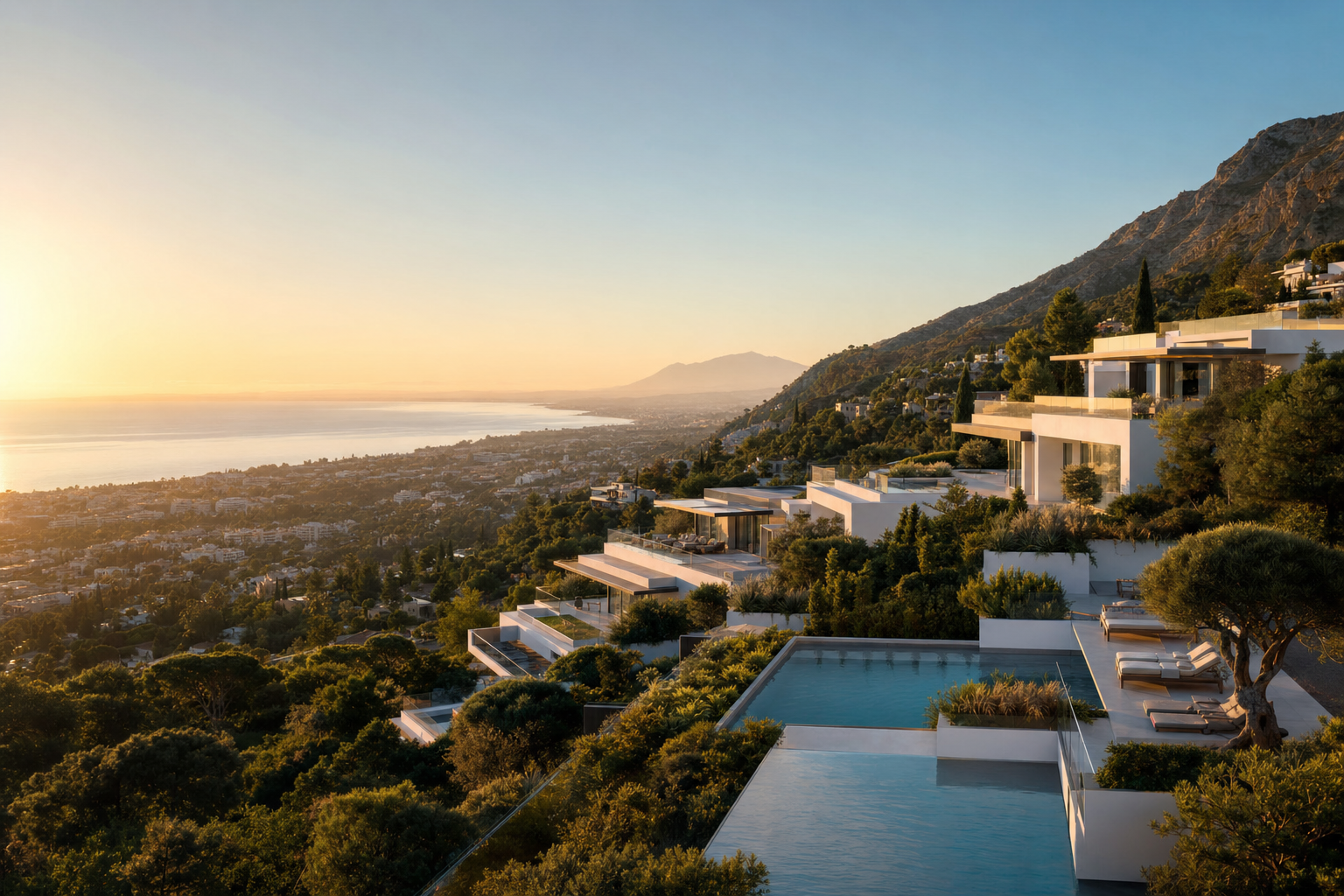
The coast is visible from almost every house in Sierra Blanca, yet you are not on it. That distinction matters more than it sounds. From 300 metres above sea level on the southern flank of La Concha, the Mediterranean sits in the middle distance — a horizontal line of blue between the pines — rather than immediately outside the terrace. The effect is one of perspective rather than proximity, and for a certain kind of buyer that shift is precisely the point.
Sierra Blanca is a gated residential district within the Marbella municipality, broadly bounded by the A-7 coastal highway below and the mountain itself above. It holds roughly 300 residences. It is not a single development but a layered accumulation of streets and sub-communities, each with its own character and its own price register, unified by 24-hour perimeter security and by the mountain backdrop that gives the area its name.
The sub-zones and what they represent
The district divides into a recognisable hierarchy without quite being a formal one. Lower Sierra Blanca — the entry tier — sits closest to the coastal road. The mid-level streets ask more, depending on orientation, plot size, and whether the build is original or has been substantially updated. Above these, and meaningfully distinct, sit Upper Sierra Blanca, the Country Club, Altos Reales, and the Marbella Hill Club. These addresses carry the zone's upper end and its most recognisable names.
Altos Reales in particular holds some of the largest plots and the most substantial individual houses in the district. The Marbella Hill Club has a members' character that has kept it cohesive over time — a private tennis and social club around which a residential community has accumulated, rather than the other way around. The Country Club streets occupy a comparable position: established, unhurried, with a density of mature planting that takes decades to achieve and cannot be replicated by a new development.
Architecture: classical and contemporary in roughly equal measure
Unlike some Marbella zones that have moved decisively toward one architectural idiom, Sierra Blanca remains divided. Roughly half the stock is classical — Andalusian-referenced, white render, terracotta tile, interior courtyards — and the other half contemporary, meaning glass-fronted volumes, flat roofs, and open-plan living spaces oriented toward the view. Both types trade, and both types attract committed buyers.
The classical houses tend to sit on the more established streets and occupy larger plots with mature gardens. The contemporary builds are often more recent, occasionally the product of a plot sale followed by a bespoke commission. In our experience, buyers who arrive with a strong preference for one tend to hold it; there is rarely a conversion. The market accommodates both because the underlying asset — the gated mountain position, the views, the proximity to Marbella town — is shared regardless of what sits on the plot.
The market, and what can be counted
How many residences change hands in Sierra Blanca in a given year is not a published fact. Spain records no completion at property level, so the turnover rates and appreciation percentages attached to this district in market reports have no source behind them, and this desk adds none. What can be stated is the register: current asking prices by zone, each with its sample size and date, are on the Marbella Property Index (museselection.es/marbella-property-index).
The published side is a partial picture. Some residences here are not published and are shown by introduction: owners tend to hold significant equity, tend not to be distressed sellers, and tend to prefer a degree of discretion about the fact of a sale at all. A buyer relying solely on advertised stock will not see everything that is available.
Position: the geographical argument
Sierra Blanca is often described by what it is not, which is a reasonable approach because position is genuinely its defining characteristic. It is not on the Golden Mile, though the Golden Mile is perhaps eight minutes by car. It is not as remote as La Zagaleta, which sits further into the hills above Benahavís with an entirely different infrastructure logic. It is not Puerto Banús, in temperament or in noise level.
What it is: a quiet residential mountain, close enough to Marbella's centre and beach clubs to use them without effort, far enough above them to be unaffected by their pace. The drive to Puerto Banús is roughly ten minutes on a clear day. The drive to Málaga airport is under forty. These are not trivial practical facts for a buyer who intends to use the property as a primary residence rather than a periodic retreat. Sierra Blanca functions as a year-round address in a way that more remote estates do not always manage.
The La Concha mountain above acts as both backdrop and windbreak. Microclimatically, the south-facing slope catches light early and holds warmth late, which affects the quality of terraces and pools across much of the year in ways that flat coastal plots at equivalent latitudes do not.
Who buys here
The buyer mix in Sierra Blanca reflects the broader upper Marbella register with some particular emphases. In the desk's own enquiries — an observation, not a count; no public dataset records buyer nationality at this price level — northern European buyers, principally British, Scandinavian, and German, are the most present. Middle Eastern buyers, typically Gulf-based, are drawn in part by the gated perimeter and the privacy logic of the district.
A smaller but growing cohort of US buyers has appeared more recently, broadly tech-founder or finance in profile, for whom Marbella represents a European base that is operationally practical — the time zone works for US West Coast business to a workable degree, and the infrastructure around the Golden Mile has matured to a point where it no longer asks for significant lifestyle compromise. Sierra Blanca appeals to this cohort specifically because it reads, in spatial terms, somewhat like a Northern California hillside address: mountain above, sea view below, discretion assumed.
Hold periods across the district tend to be long. Buyers who arrive typically stay. Turnover, when it occurs, is usually life-event driven — estate matters, a consolidation of residences, a family reconfiguration — rather than speculative.
What the zone does not offer
It is worth being direct about the constraints, because they are real. Sierra Blanca is a car-dependent address. The walk to the beach is not practical for daily use; the walk to a supermarket is not practical at all. This is a district for people who are comfortable with that model — who regard the drive to the coast as a choice rather than an inconvenience. Buyers who want to open the gate and walk to a beach club will find the Golden Mile a more natural fit.
The architecture of the existing stock also means that genuine turnkey contemporary product at the upper end is relatively scarce. There are excellent houses, but a buyer seeking a specific combination — say, a large flat-roofed glass pavilion on a substantial upper-zone plot with unobstructed sea views — may find that the available inventory requires either a wait for the right moment or a willingness to buy land and build. Both paths are viable; neither is immediate.
The quality of stillness
There is a quality that Sierra Blanca has that is difficult to reduce to a metric but that buyers who have spent time there tend to mention without prompting. The district is quiet in the evenings in a way that the coast is not. Sound carries differently at altitude; the mountain absorbs rather than reflects. Nights are measurably cooler in summer, which affects sleep in ways that anyone who has spent a July night on the coastal strip understands.
None of this is new. Sierra Blanca has been an established address for three decades, and the fact that it has not been substantially redeveloped in that time — that the mature planting is still there, that the density has not crept upward, that the perimeter has held — is not an accident. It reflects an ownership culture that values what the place already is.
That culture is, in the end, what a buyer is buying into as much as any individual house.