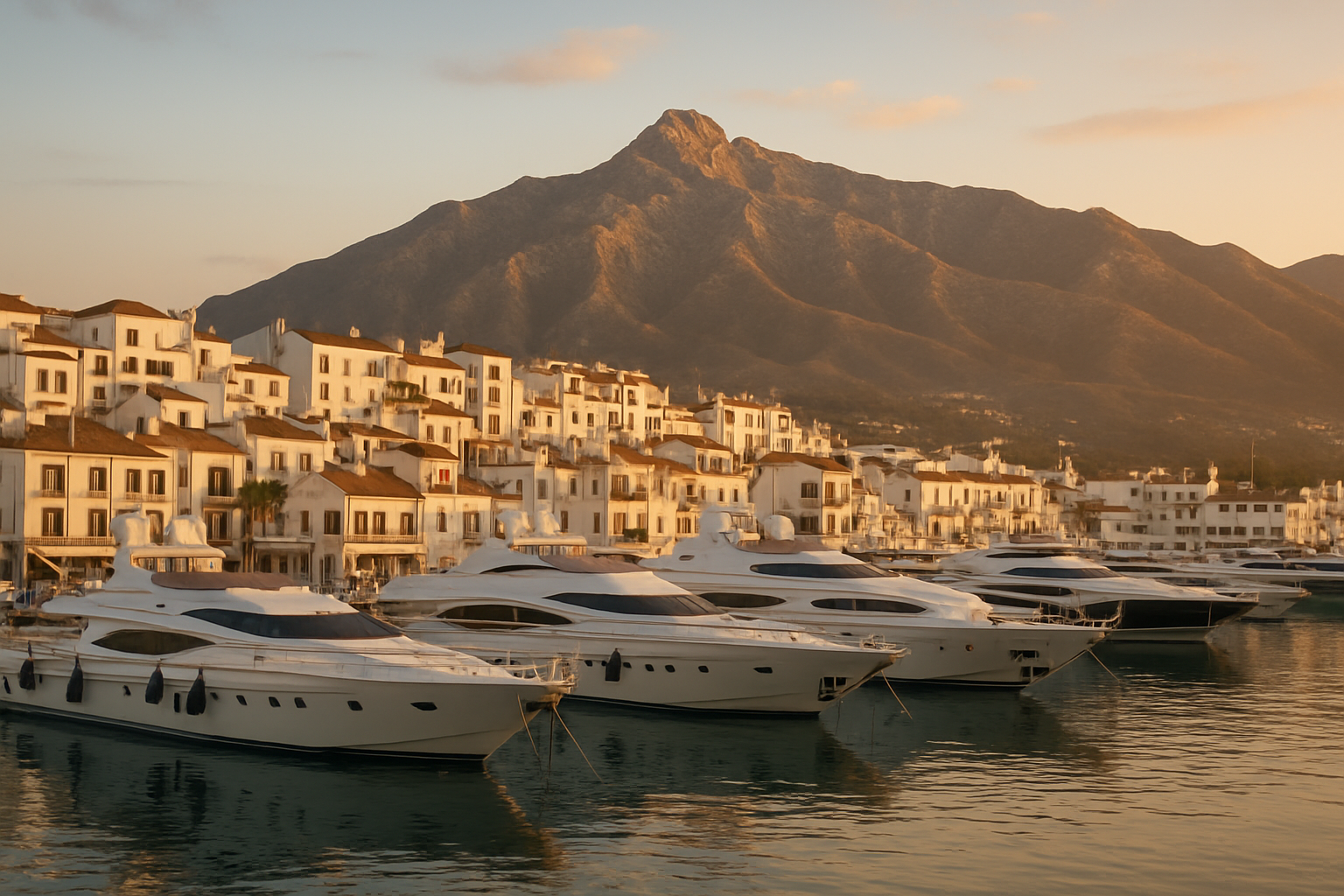
The road west from Marbella runs close to the water for a long time, then pulls inland just before Estepona and deposits you, eventually, at a set of gates that feel unhurried. Sotogrande does not announce itself. The estate was masterplanned in 1962 by Joseph McMicking, a Manila-born American businessman who bought a large tract of Andalusian scrubland with a precise idea of what it should become: low density, wide roads, golf, horses, and the kind of resident who does not need to be seen. More than sixty years on, that idea is still largely intact.
It sits in the municipality of San Roque, just before the Strait of Gibraltar makes itself visible on clear mornings. The proximity to Gibraltar is practical for some buyers — direct flights, a distinct legal and financial infrastructure — and atmospheric for everyone. The air is different here: cooler, more Atlantic than Mediterranean, carrying weather that Marbella deflects off La Concha.
What the estate actually contains
Sotogrande is not a single residential zone but a cluster of distinct submarkets, each with its own character and its own price register. Understanding which part you are evaluating matters more here than in most comparable estates on the coast.
Sotogrande Costa is the original. The beachfront and central residential grid laid down in McMicking's plan: generous plots, mature pines, an unhurried streetscape that has been added to carefully rather than transformed. Properties here sit closest to the beach club infrastructure and to the polo fields of Santa María, which host some of the highest-handicap amateur polo in Europe every summer. The families who return each year for the polo season — Anglo-Argentine, broadly, with a Madrid and London overlay — have shaped the social texture of the estate more than any single piece of architecture. This is not the Marbella Golden Mile; there is no boulevard, no visible display. The wealth is old enough to be invisible.
Sotogrande Alto occupies the hillside above, cooler and more private, with larger plots and longer views toward Morocco on clear afternoons. The scale of the land is different up here, and the buyer profile shifts accordingly toward those who want acreage rather than proximity to a beach club.
La Reserva: the transformed plateau
The most significant change to Sotogrande's buyer composition over the past decade has happened on the inland plateau of La Reserva de Sotogrande. The development was already notable for the Cabell B. Robinson golf course, a layout that rewards patience more than power, but the opening of The Beach in 2017 changed the register entirely. A Crystal Lagoon — a technology-enabled body of water the size of a small lake, saltwater-blue and swimmable — arrived in a landscape that had previously offered only fairways and scrubland. It drew a younger cohort: Madrid tech founders, American families who had been cycling through Ibiza and were ready for something more permanent, European principals for whom Marbella felt architecturally crowded.
La Reserva now functions as something close to a standalone destination within the estate. The golf, the lagoon, the proximity to Valderrama without the formality of its membership culture — these combine in a way that has made the plateau the part of the estate newer buyers ask about first. In our experience, buyers arriving at Sotogrande via La Reserva often need to be walked back through the wider estate before they understand what they are choosing between. The plateau is newer, shinier, and immediately legible. The Costa and Alto require more time to read.
The Marina
Sotogrande Marina is a separate proposition from the residential estate, both physically and in terms of what it offers. It is an inland marina — a canal system that brings berths close to apartments and townhouses in a format borrowed, loosely, from Puerto Banús, but operated at lower volume. It functions well as a base for those who want to be on the water but find Marbella's marina too dense in season. The restaurants and chandleries are modest by comparison with Puerto Banús; that is, for the most part, the point.
Four courses, ten minutes
The golf density around Sotogrande is the highest concentration of serious golf real estate on the Iberian Peninsula. Valderrama, which hosted the 1997 Ryder Cup and remains arguably the most demanding layout in Spain, sits inside the estate. Real Club de Golf Sotogrande, designed by Robert Trent Jones Sr. in 1964 and one of the oldest private clubs in Andalusia, is three minutes away. La Reserva Club has its own course. Almenara, a longer and flatter layout, adds a fourth option within the same radius.
This matters beyond the obvious. In residential markets where golf is genuinely central — rather than decorative, as it can be along other parts of the coast — the golf clubs act as long-term anchors for value and for the community of buyers who return annually. La Zagaleta, forty kilometres east, has two private courses and a similarly stable ownership culture; the network of existing owners there absorbs much of what moves before it surfaces publicly, which is precisely why no one can put a share on it. Sotogrande's dynamic is comparable. Residences here, particularly in the Costa and Alto, move quietly, often through introductions rather than open listings.
The buyer profile, honestly described
Sotogrande has always attracted a specific type of principal: someone for whom the activity itself — polo, golf, sailing — is not a lifestyle accessory but a reason for being there. That remains true. The polo families have been coming for two and three generations in some cases. The golf membership culture at Valderrama and Sotogrande is self-selecting in the way that serious clubs are.
What has changed is the addition of a second cohort: buyers in their late thirties and forties, often American or Northern European, often with backgrounds in technology or private equity, who have looked at the Costa del Sol carefully and concluded that Marbella's density and visibility are not what they want. They find La Reserva first, because it has the kind of amenities — the lagoon, the contemporary architecture, the rental infrastructure — that register immediately. Some stay in that submarket. Others, over time, move toward the older parts of the estate.
The Spanish buyer — Madrid industrialists, Basque families — has always been present and remains so. Sotogrande is close enough to Madrid by private air that it functions as a long-weekend destination as readily as a summer base.
What Sotogrande is not
It is not Marbella. That distinction is worth stating plainly, because buyers who arrive comparing the two sometimes reach Sotogrande looking for something and leave having found something else.
Marbella's Golden Mile offers a 4-kilometre coastline of concentrated luxury, roughly 800 residences, and a social infrastructure — the restaurants, the beach clubs, the port — that is deliberately visible. Sotogrande's social life happens inside the estate, inside the clubs, on the polo field. It does not present itself to the road. The buyers who thrive here are, broadly, those for whom that inward orientation is a feature rather than a limitation. The asking medians for both zones, each with its sample size and date, are on the Marbella Property Index (museselection.es/marbella-property-index).
The quietness is not a marketing description. It is structural — a consequence of the original masterplan's density limits, the size of the plots, the absence of a high street, and the self-sufficiency of the community that has formed around the golf and polo infrastructure over six decades. You can spend a fortnight at Sotogrande and have no reason to leave the estate. Many owners do exactly that.
A note on the wider picture
For those assembling a fuller view of this stretch of coast, Sotogrande sits at the western end of a corridor that runs through Estepona, Benahavís and the Marbella belt before reaching the Golden Mile and Puerto Banús. Each zone has its own logic. Sotogrande's logic — low density, activity-led, quiet by design — is the most distinct of them. [The Sotogrande residential guide on our site](/districts/sotogrande) covers the submarket breakdown in more detail, with current inventory across all four zones.
What tends to stay with buyers after a first visit is not a specific property or a price point but the particular quality of the silence in the middle of the estate on a weekday morning, the courses empty except for a few members, the polo ponies somewhere behind a stand of pine. McMicking planned for that. It has proved more durable than most things planned in 1962.