Guadalmina Baja
Guadalmina Baja is the beachside half of the coast’s second-oldest golf estate: a low, quiet grid of large plots between the A-7 and the sea, laid around the fairways Javier Arana drew in 1959, with the Guadalmina river as its western edge and a Roman bath house standing on its beach.
3 residences on offer.
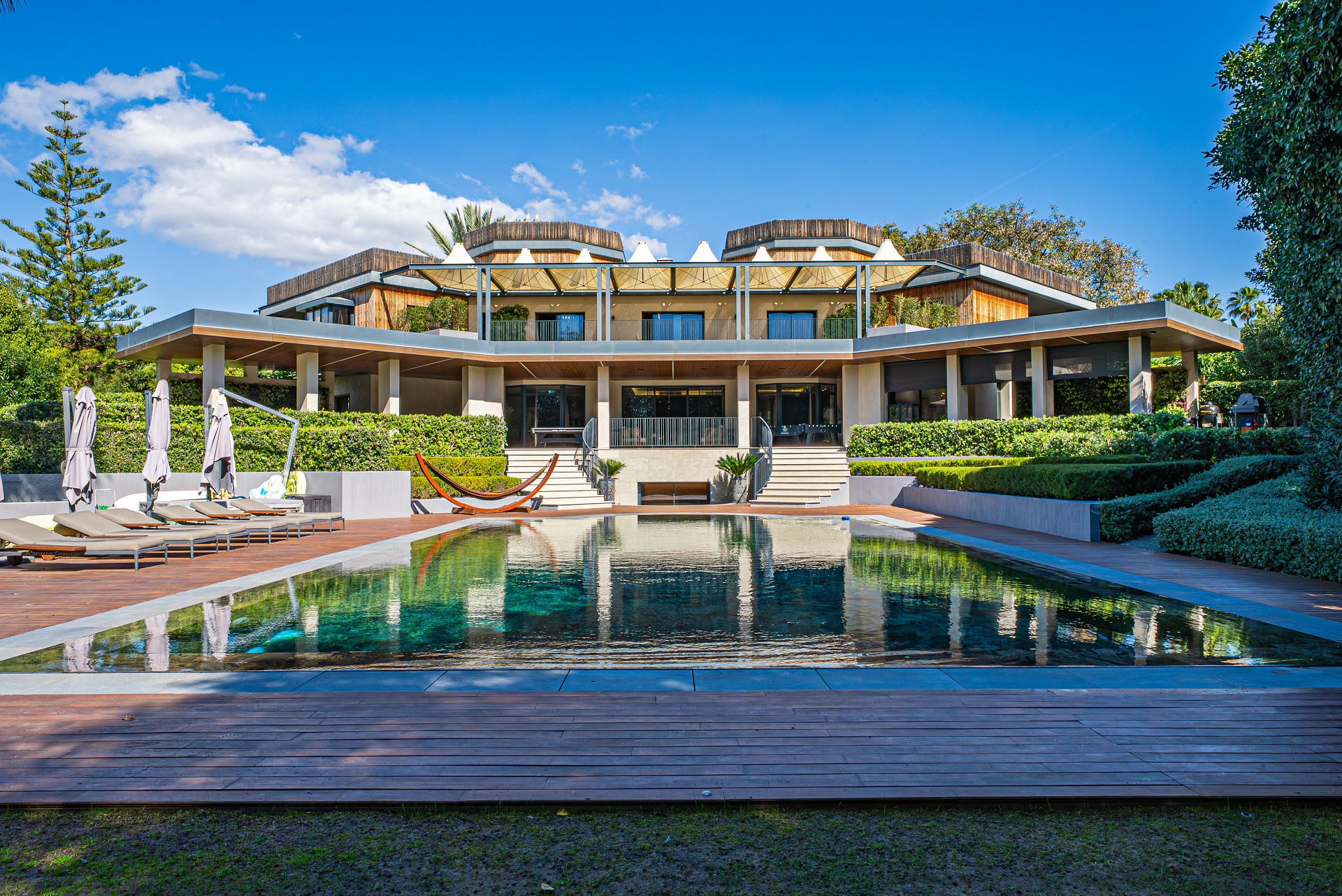


Guadalmina Baja is the seaward half of the Guadalmina estate, immediately west of San Pedro de Alcántara: villas on broad flat plots between the A-7 and the beach, threaded by the South course of the Real Club de Golf Guadalmina, ending at the Guadalmina river. On the 12 August 2026 register snapshot it holds four priced listings at or above €1,500,000 — median asking price €5,150,000, median €8,150 per square metre.
Four is the register’s minimum publishable sample, and this page says so before a reader has to ask. The register publishes a zone median from four priced listings upward and prints nothing below — Sierra Blanca has no row for exactly that reason — so Guadalmina Baja’s figures clear the bar by nothing at all. A median of four asking prices describes those four sellers almost as much as it describes a market; it will move between snapshots, and it is published with its n so a reader can weigh it accordingly.
The range says more than the median here. The four listings ask from €4,750,000 to €12,900,000 — a lower bound more than three times the register’s €1.5M floor. In most zones the cheapest listing sits at or just above the floor, which tells you the register is truncating a deeper market beneath it; Finca Cortesín and Guadalmina Baja are the two zones on this register that price their own entry. Below the luxury index the estate does hold smaller product — the full €350,000-floor catalogue listed 31 residences here the day this page was written, most of them apartments and penthouses near the estate’s edges — but the villa heart of Baja starts where most zones end.
The estate has one origin and it is documented. In 1934 Norberto Goizueta, a Basque agronomist who had found the land from the sea the summer before, bought roughly four hundred hectares of farmland either side of the Guadalmina river. The farm became the coast’s second golf estate: the Guadalmina Hotel and the first nine holes of the South course opened in 1959 — Javier Arana’s design, the second-oldest course on this coast — with the second nine following four years later. The club received the royal title in 2008, after half a century of golf. All of this predates Puerto Banús by a decade; when Guadalmina Baja was laid out, the marina next door was still a beach.
The place today is what the plan implied: wide, flat, quiet streets under mature gardens, plots that run large by beachside standards, and almost nothing to do — which is the point. The South course threads between the residences down to the sea; the beach runs unbroken from San Pedro’s promenade to the river mouth. There is no commercial strip inside Baja itself: the estate’s shops, banks and restaurants sit across the road in Guadalmina Alta, and San Pedro’s boulevard is five minutes east.
At the river mouth, on the estate’s own beach, stand the Roman baths of Las Bóvedas — an octagonal domed hall of the second century, among the best-preserved Roman remains on this coast — with a later coastal watchtower beside them and the early-Christian basilica of Vega del Mar in the grove just east. The shoreline here has been valuable for eighteen hundred years; the Ley de Costas paragraph below is older law than it looks.
Position, then, with the thin-sample caveat attached. Baja’s €8,150 per m² (n=4) sits beside Guadalmina Alta’s €8,273 (n=5) — on samples this size, read the two halves as level on the metre — above Marbella city (€7,968 · n=40) and below Nueva Andalucía (€8,652 · n=59) and the Marbella Golden Mile (€9,099 · n=56). The headline median is another matter: at €5,150,000, Guadalmina Baja’s ticket exceeds the Golden Mile’s (€4,370,000 · n=56) on the same snapshot. Composition, not mystery: the published sample is whole beachside villas on land, and the entry ticket is high even while the metre stays coastal-normal.
Spain publishes no per-property closing prices, and for an urbanisation of Guadalmina Baja’s size no public aggregate resolves to the estate at all. Transaction counts, days-on-market, sold-price movement, rental yields: none of it exists in any public dataset for this address, and anyone quoting those figures is estimating at best. This desk publishes the asking-price row, its n and its date, and stops there.
Qualitatively — the register measures listings, not buyers — Baja’s market conducts itself like the established estate it is: long holding, slow turnover, and a meaningful share of what changes hands agreed quietly between neighbours and their lawyers before a listing appears. That is an observation about conduct, not a statistic; no dataset measures off-market share, and we decline to invent one. It is also the honest explanation of the four-listing sample: the estate is not thinly held, it is thinly marketed.
The mechanics are standard Spain — reservation, private purchase contract, completion before notary — with three estate overlays. The frontline sits against the public maritime-terrestrial domain under the Ley de Costas, so the planning file and any concession status lead the legal review. Much of the stock dates from the 1960s to the 1990s, which makes the technical survey and the reform licensing path as important as the price — first-generation villas on good plots here are increasingly bought for their land. And the community’s statutes and quotas belong in the first document request; the municipality is Marbella, through the San Pedro district office.
The measured data, and what sits beside it.
From the gate of Guadalmina Baja.
Schools, healthcare, golf and the coast.
Asked, before the first visit.
- What is Guadalmina Baja?
- Guadalmina Baja is the beachside half of the Guadalmina estate, immediately west of San Pedro de Alcántara in the Marbella municipality: large villa plots between the A-7 and the sea, laid around the South course of the Real Club de Golf Guadalmina (Javier Arana, 1959), bounded west by the Guadalmina river. The estate dates to Norberto Goizueta’s 1934 purchase of the Guadalmina farmland and predates Puerto Banús by a decade.
- How much does property in Guadalmina Baja cost?
- On the Muse Selection live register (snapshot 12 August 2026, €1.5M floor), Guadalmina Baja shows a median asking price of €5,150,000 across four priced listings, ranging from €4,750,000 to €12,900,000. Four is the register’s minimum publishable sample, so the median should be read as indicative and dated. These are asking prices — Spain publishes no per-property closing prices — and smaller apartment and penthouse stock exists below the €1.5M index floor.
- Is a four-listing sample enough to price Guadalmina Baja?
- It is enough to publish and no more. The register publishes a zone median from four priced listings upward and refuses below that — Sierra Blanca carries no row for exactly that reason — so Guadalmina Baja clears the bar by nothing. A median of four describes those particular residences as much as a market, which is why every figure on this page carries its sample size and snapshot date. The thinness itself is informative: the estate is thinly marketed, not thinly held.
- What is the price per square metre in Guadalmina Baja?
- The register measures a median asking €8,150 per m² across four priced listings, snapshot 12 August 2026 — beside Guadalmina Alta’s €8,273 (n=5), above Marbella city’s €7,968 (n=40) and below the Marbella Golden Mile’s €9,099 (n=56). On samples of four and five, the honest reading is that the estate’s two halves are level on the metre; the difference between them is the ticket and the product behind it.
- Guadalmina Baja or Guadalmina Alta — what is the difference?
- One estate, two halves, the A-7 as the line. Baja is the beachside: larger plots, the South course, the frontline, and a median asking price of €5,150,000 (n=4, 12 August 2026) with entry at €4,750,000. Alta is the inland half around the 1973 North course: villas and townhouse communities, the estate’s commercial centre and school, and a €3,950,000 median (n=5) with entry at €1,900,000. Per square metre they are level — €8,150 against €8,273 — so the gap is the ticket, not the metre.
- What golf history does Guadalmina have?
- The Real Club de Golf Guadalmina is the second-oldest club on this coast. Its South course, designed by Javier Arana, opened its first nine holes in 1959 beside the Guadalmina Hotel, with the second nine completed four years later; the North course followed in 1973 under Folco Nardi. The club received its royal title in 2008. When the South course opened, Puerto Banús did not yet exist — Guadalmina is where resort golf west of Marbella began.
- What are the Roman baths on the Guadalmina beach?
- Las Bóvedas — “the vaults” — a second-century Roman bath house whose octagonal central hall still stands at the mouth of the Guadalmina river, on the estate’s own beach, with a later coastal watchtower beside it. A few hundred metres east, in the grove behind the beach, stands the early-Christian basilica of Vega del Mar with its burial ground. Both sites sit on the line of the Roman road from Cartagena to Cádiz.
- Is Guadalmina Baja a good investment?
- No honest answer can cite realised returns: Spain publishes no per-property closing prices, and for an estate of this size no public aggregate resolves to the address at all. What can be measured on 12 August 2026: an entry price of €4,750,000 — more than three times the register floor, a structure only Finca Cortesín shares on this register — level per-metre pricing with the estate’s inland half, and a fixed beachside perimeter with no new land. Scarcity is structural; returns are unknowable from public data.
Residences in Guadalmina Baja are shown by appointment.
If we haven't yet met, please mention how you found us. Allow ninety minutes; bring no expectations.
Look at Guadalmina Baja now
Describe it in your own words — or ask our adviser.